When One AI Model Becomes Production's Single Point of Failure


Table of Contents
- Introduction
- Why does treating one model as the universal backend correlate failures across automations?
- What is silent degradation in LLM-backed pipelines and why is it an incident risk?
- How does prompt drift happen and why should change management treat prompts like code?
- What do production incidents look like when a vendor throttles, deprecates, or goes down?
- Who owns the AI path in production and how should escalation read on paper?
- What rollback and blast-radius controls should exist before go-live?
- How do hybrid routing and stronger observability shrink the failure domain?
- Frequently Asked Questions (FAQs)
Introduction
If you have ever defended a single-vendor, single-model setup for AI automations, you probably had good reasons. One integration to secure, one quota to negotiate, one mental model for the team. That is not greed for simplicity. It is how real organizations ship when calendars are full and headcount is tight.
The uncomfortable part is that production reliability is not decided at the architecture review where everyone nods at the diagram. It is decided the first Tuesday when the model quietly starts answering in a slightly different format, when marketing edits a prompt in a no-code panel without a changelog, or when the provider returns 429s for two hours and every critical flow shares the same choke point. None of those failures are fundamentally about token price. They are about correlated risk, weak rollback, and monitoring that still thinks "green" means "correct."
This article is written for people who carry a pager, a rotation, or at least the blame when customers notice before dashboards do. The goal is practical: name the failure modes that do not look like classic outages, spell out what should already exist in docs before the incident, and connect that work to hybrid routing and observability so the failure domain stops being "everything that calls the same endpoint."
Why does treating one model as the universal backend correlate failures across automations?
When every workflow funnels through the same model identifier, you inherit a hidden dependency graph. Invoice extraction, ticket summarization, routing labels, and customer-facing replies may live in different repositories or no-code graphs, but they share one behavioral surface. If that surface shifts, the failures move in sync. That is the textbook definition of correlated incidents, and it is painful because remediation is not "restart the bad box." It is "re-validate dozens of prompts and downstream parsers while the business still expects output."
The correlation is not only about outages. It is about any change that alters token patterns, formatting, or tool-use behavior. A provider-side adjustment that improves average benchmark scores can still break a brittle JSON envelope your CRM import expects. If every pipeline trusted the same envelope style, you do not get one broken job. You get a wave of partial successes that look fine until data lands wrong in a system of record.
Capacity is part of the same story. Shared rate limits and concurrency caps mean a traffic spike in one product surface can starve another. That is not a moral failure of the platform team. It is physics when everything queues against the same account limits and the same model route.
How is this different from traditional single-dependency outages?
Classic single points of failure, like one database primary, at least fail loudly enough that metrics move. You see connection errors, replication lag, or saturation. AI endpoints often return 200 responses while quality collapses. Even when the dependency is "up," the system can be wrong in ways that only a domain expert spots. That moves the problem from infrastructure monitoring into product and operations judgment, which is exactly where runbooks are weakest when nobody wrote them.
What is silent degradation in LLM-backed pipelines and why is it an incident risk?
Silent degradation is what happens when outputs remain syntactically valid and latencies look normal, but semantic quality drifts enough to harm decisions.
Silent degradation is what happens when outputs remain syntactically valid and latencies look normal, but semantic quality drifts enough to harm decisions. Examples include summaries that drop negation, extractions that swap IDs across columns, classifications that skew a few points and reroute work, or answers that invent policy language that sounds official. The API did not throw. The workflow node turned green. The damage shows up as rework, customer complaints, or audit findings days later.
That delay changes incident severity. By the time someone files a ticket, bad data may have propagated through queues, caches, and downstream transforms. You are no longer rolling back a single deploy. You are asking how much you trust everything produced since the drift began, which is an ugly question without sampling, golden tests, or retained exemplars.
Silent degradation also trains teams to distrust automation without giving them a lever. If the official story is "the model is fine because the dashboard is fine," operators learn to work around the system instead of improving it. That is how shadow prompts and duplicate flows appear, which only widen the blast radius the next time something shifts.
Which signals beyond latency and error rate actually matter?
Latency and HTTP status are necessary. They are not sufficient. Useful observability for LLM paths usually layers in task-specific signals: schema pass rate, validator rejections, embedding distance from reference answers on a fixed golden set, human review disagreement rate, business KPIs tied to automation outcomes, and drift in categorical distributions when you expect stability. You are trying to catch "wrong but plausible" before it becomes "wrong but committed."
Sampling helps when full evaluation is too expensive. The point is not perfection on every request. The point is a steady, comparable slice that breaks your illusion of stability when quality moves. Pair that with trace identifiers so an operator can connect a bad customer outcome to the exact prompt version, model ID, and retrieval snapshot. Without that linkage, postmortems devolve into opinions.
How does prompt drift happen and why should change management treat prompts like code?
Prompt drift is any production behavior change that comes from edits to instructions, examples, tool definitions, or retrieval configuration without a disciplined release.
Prompt drift is any production behavior change that comes from edits to instructions, examples, tool definitions, or retrieval configuration without a disciplined release. It shows up when a well-meaning analyst tightens wording in a live template, when a developer hot-fixes a string in production, or when two environments diverge because prompts live in a SaaS UI instead of version control.
The operational mistake is treating those edits like copy tweaks. For the runtime, they are behavior changes. They deserve review, staging, canaries, and rollback the same way you would treat a code path that parses money. If your organization cannot say what prompt version served a given hour of traffic, you do not have configuration management. You have folklore.
Strong teams store prompts in git or an equivalent system with hashes surfaced in logs, map prompt versions to model versions explicitly, and block "save to prod" buttons for high-risk flows unless a second person approves. You do not need a heavyweight process for every experiment. You need a bright line between playgrounds and production identities.
What do production incidents look like when a vendor throttles, deprecates, or goes down?
Vendor incidents come in a few recognizable shapes. Hard outages are the easy ones: elevated 5xx, DNS issues, regional failures. Throttling is nastier because it can present as intermittent timeouts or truncated responses under load, which looks like flaky code until you graph quota and concurrency. Silent capacity shaping, maintenance windows, and deprecations with sunset dates are another category entirely. Your automation keeps calling an identifier that still exists but routes to a different behavior profile, or it keeps working until the cutoff date arrives and every workflow fails at once.
From an incident-commander perspective, the missing piece is often a pre-written decision tree. When the provider degrades, do you fail closed, fail open to a human queue, switch to a secondary model route, or degrade features? If that decision only gets made under stress, you will choose the fastest patch, not the safest one. Document the options when you are calm, then rehearse them in tabletop exercises if you can.
Who owns the AI path in production and how should escalation read on paper?
Ownership gaps are how AI incidents become week-long mysteries. The application team assumes the platform team watches the model. The platform team assumes the vendor handles quality. Security assumes prompts are static. Nobody owns the golden tests. Escalation should name roles, not vibes.
A minimal ownership doc answers: who approves model or prompt changes for each tier of risk, who is primary on-call for workflow failures versus provider outages, who can authorize a temporary route change, and who speaks to legal or customer communications if outputs caused harm. It should also list vendor contacts, account IDs, and links to status pages. This is boring paperwork until 3 a.m., when it saves an hour of Slack archaeology.
Escalation levels ought to mirror severity. A localized parser failure might stay with the product team. Widespread format drift might engage data engineering and the vendor. Customer-visible harmful guidance might pull in security and policy owners immediately. The mistake is routing everything to "the AI person" if that person has no production authority.
What rollback and blast-radius controls should exist before go-live?
Rollback for AI is rarely a single git revert. It is a bundle: pinned model identifiers, prompt version tags, retrieval index snapshots where relevant, feature flags that can disable specific automations, and queue drains that stop bad output from fanning out. You want the ability to return to a last-known-good configuration without redeploying the entire platform.
Blast-radius controls include splitting traffic by workflow, capping concurrency per critical path, requiring human approval on high-stakes outputs, and isolating experimental prompts behind flags. The theme is the same as any mature release system: make bad changes small, observable, and reversible.
Before production, run a failure drill. Turn off the primary model route on purpose in staging. Verify the secondary path activates, that alerts fire, and that operators know which runbook step comes first. If you cannot simulate it, you do not truly have failover. You have a diagram.
How do hybrid routing and stronger observability shrink the failure domain?
Hybrid routing is not about collecting models for sport. It is about decoupling workflows so they do not share one behavioral monoculture. Route structured extraction to models and settings tuned for documents, keep customer language on paths with stronger policy tooling, and maintain a cold-standby or warm-secondary route that can absorb load when the primary degrades. Even coarse rules reduce correlation compared with a single global default.
Observability completes the picture because routing without measurement is guessing. You need per-route health, not just global uptime. Compare outcomes across routes on the same golden set. Watch for divergence when you fail over. If secondary routes are never exercised, they will fail the first time you need them.
Orchestration layers such as n8n help because they centralize retries, branching, and secrets while still letting you keep multiple model endpoints behind clear interfaces. The reliability win is operational: you can see executions, attach consistent logging, and swap routes without rewriting every integration from scratch. Hybrid routing plus a workflow engine is how many teams make failover a configuration change instead of an emergency refactor.
Frequently asked questions
Quick answers on the topics covered in this article.
It is any component whose failure or behavior change can take down or corrupt multiple workflows at once. A shared model endpoint is a common example when prompts, parsers, and business logic all assume one stable behavioral profile.
Because services can remain available while outputs become wrong in subtle ways. Traditional alerts based on errors and latency often stay green, so you need quality signals, sampling, and traces tied to prompt and model versions.
Prompt drift is unintended behavior change from edits to instructions, examples, or retrieval settings. Prevent it by versioning prompts, requiring review for production changes, and logging prompt hashes or IDs alongside each request.
Predefine failover behavior: secondary model routes, human queues, degraded modes, or pausing non-critical flows. Document who can authorize switching routes and how to revert when the vendor recovers.
Provider status links, account identifiers, how to identify prompt and model versions in logs, golden-set checks, steps to disable specific automations via flags, escalation names, and customer communication templates for harmful or incorrect outputs.
No. Even simple rule-based routing, a secondary endpoint, and a small evaluation set reduce correlation. The goal is architectural separation and practiced failover, not a perfect optimization engine on day one.
Schema validation rates, task-specific accuracy proxies, drift in label distributions, human review disagreement, business metrics tied to automation outcomes, and comparison metrics between primary and secondary routes on shared test inputs.
Stop the flow, identify the time window and configuration versions involved, use traces to scope impact, issue corrections or reprocessing where possible, and communicate transparently using pre-approved templates. Prevention next time means faster detection and smaller release batches.
Name explicit owners per tier of risk: product or domain for content, engineering for implementation, security or legal for policy-sensitive flows, and platform for quotas and routing. Ambiguity is what turns incidents into cross-team hunts.
Per-route metrics let you see when a secondary path diverges or degrades, prove failover during drills, and catch regressions after changes. Without per-route signals, hybrid routing is blind redundancy instead of controlled reliability.
Share this article
Related workflows
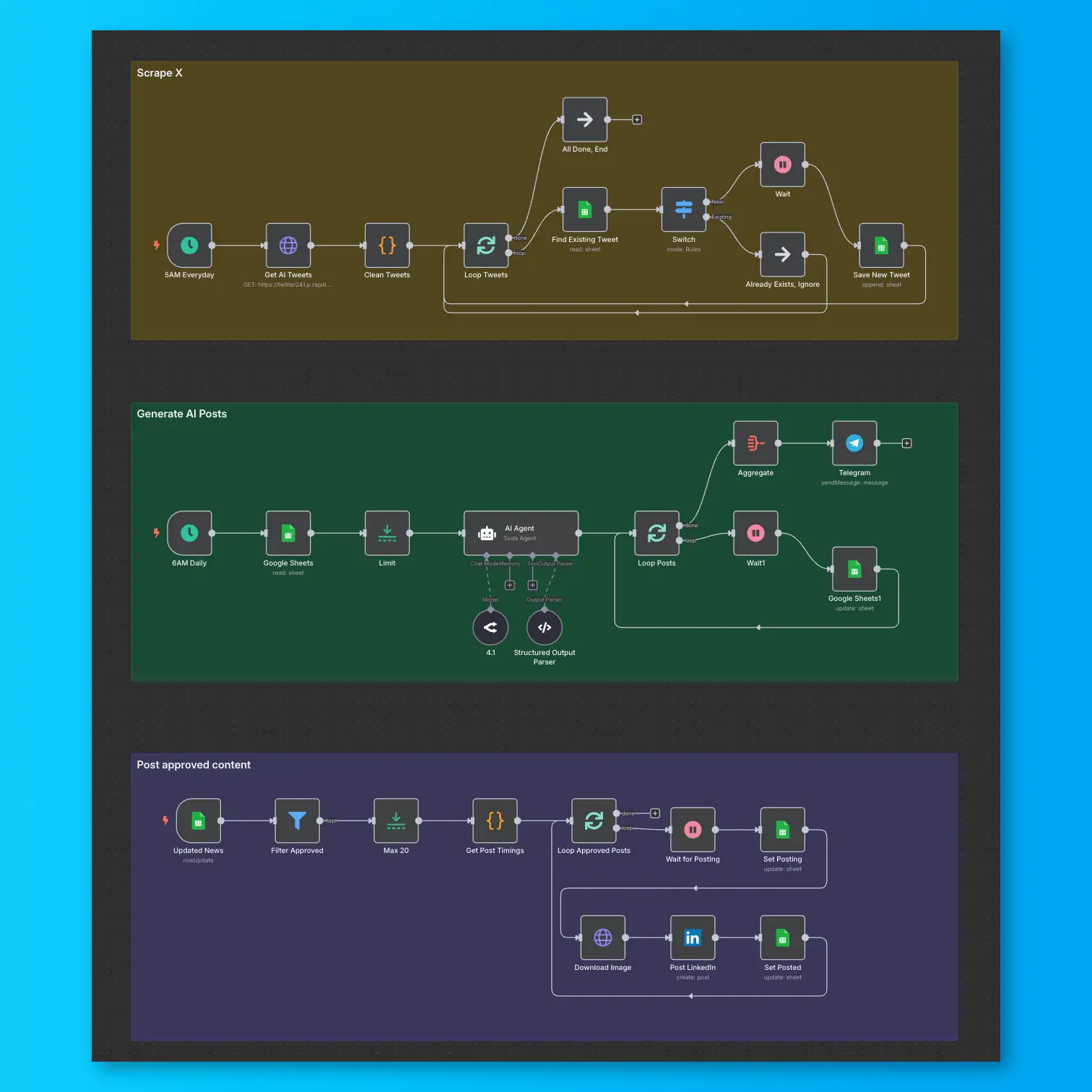
LinkedIn Automation From X Posts
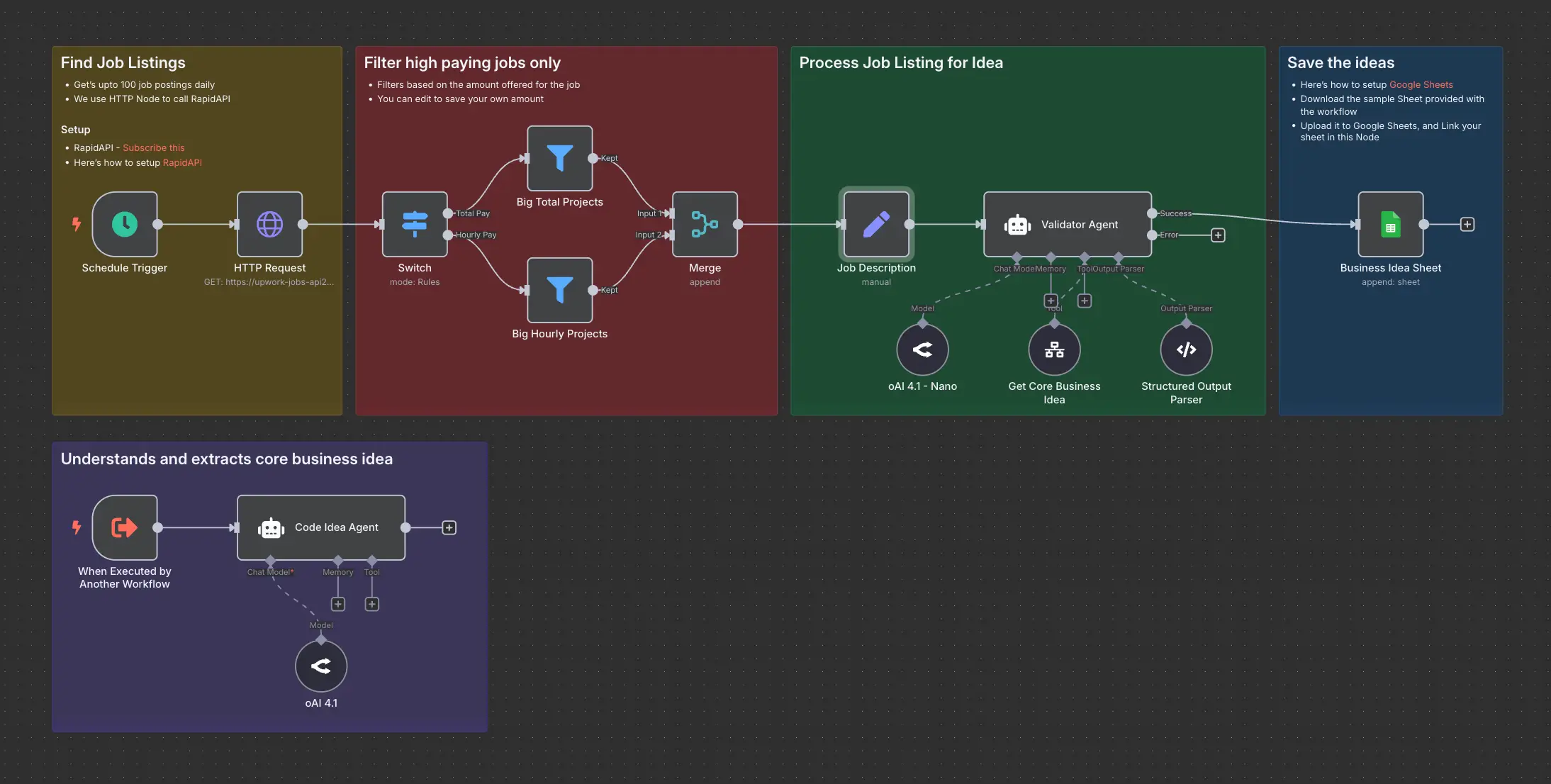
Daily Validated Business Ideas using n8n and Upwork