Why Do Your Best WhatsApp Leads Never Reach the CRM? (2026)
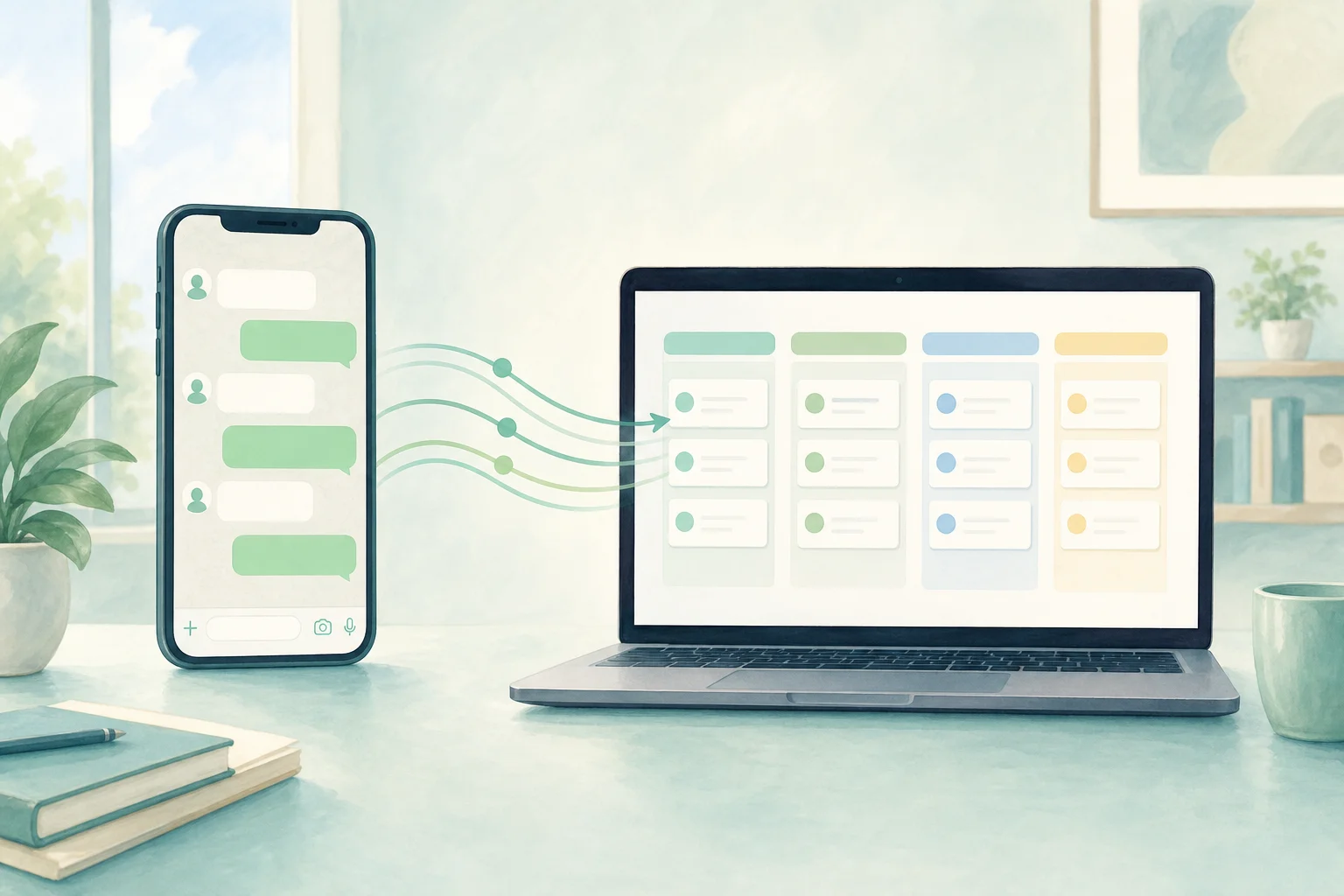

Table of Contents
- Introduction
- Why do hot WhatsApp leads disappear before they hit your CRM?
- What is WhatsApp automation with Claude and how does the stack work?
- How do the 24-hour window and template rules shape Claude replies?
- When should you use Claude Haiku vs Sonnet in WhatsApp workflows?
- How do human-approved sends and escalation gates reduce risk?
- What should you automate first in a WhatsApp Claude pipeline?
- When should you book a roadmap call instead of buying another chatbot?
- Frequently Asked Questions (FAQs)
Introduction
Your team replies fast on WhatsApp. Prospects get answers. Then someone asks in the Monday standup: "What happened to the buyer who asked about the enterprise plan Thursday night?" Silence. The thread lives on an agent's phone. Nothing in HubSpot. No task. No owner.
That is not a speed problem. It is a CRM logging gap. You already know slow replies cost deals - see WhatsApp time to lead for that angle. This post is for ops founders whose bigger leak is context that never leaves the chat app.
WhatsApp automation with Claude closes that gap: Cloud API webhooks into n8n, Claude qualifies and structures the conversation, your CRM gets a real record, and humans still approve anything that commits money or reputation.
Why do hot WhatsApp leads disappear before they hit your CRM?
Hot WhatsApp leads disappear because replies happen in the channel but logging depends on human discipline after the fact. A rep answers at 9 p.m., asks budget and timeline in chat, gets a verbal yes - then closes WhatsApp and forgets to update the CRM until Friday.
Three patterns make it worse. Personal business numbers scatter threads across phones with no shared inbox. Handoffs drop context when shifts change. Volume spikes mean "I'll log it later" becomes never.
The buyer experienced a good conversation. Your pipeline shows a cold lead or no lead at all. Marketing reports strong click-to-WhatsApp performance while sales swears WhatsApp is chaos. Both are true because the integration layer is your team's memory, the same failure mode as form to CRM to spreadsheet glue work, just on a channel where buyers expect instant, continuous dialogue.
What is WhatsApp automation with Claude and how does the stack work?
WhatsApp automation with Claude is a server-side pipeline where inbound Business API messages are interpreted by Claude, written to your CRM, and answered through approved workflows - not the mobile app. The core stack is WhatsApp Business Platform (Cloud API or BSP), n8n as orchestration, Anthropic's API for language intelligence, and your CRM as system of record.
The flow looks like this:
- Customer messages your verified business number.
- Meta or your BSP forwards the payload to an n8n webhook (
from, message body, timestamps, and increasingly BSUID identity fields). - n8n loads conversation history from a database or CRM note field.
- Claude classifies intent (lead, support, spam), extracts structured fields, and drafts a reply.
- n8n writes the lead record to HubSpot, Pipedrive, or a sheet - before or alongside the reply.
- The reply goes back through the Cloud API. High-risk drafts wait for human approval.
Claude is not a replacement for WhatsApp. It is the interpreter and drafter sitting between Meta's transport layer and your revenue systems. Optional MCP connectors reduce copy-paste when your team already lives in Claude Desktop, but n8n remains the reliable production spine for webhooks, retries, and audit logs.
{
  "model": "claude-haiku-4-5-20251001",
  "max_tokens": 512,
  "system": "You qualify inbound WhatsApp leads for [Business]. Output JSON: intent, budget, timeline, contact_preference, suggested_reply. Never invent pricing.",
  "messages": [{"role": "user", "content": "{{inbound_text}}"}]
}
That pattern keeps the model on a leash: structured output for CRM writes, natural language only for the customer-facing draft.
How do the 24-hour window and template rules shape Claude replies?
The 24-hour customer service window means Claude can send free-form replies only while the user has messaged you within the last 24 hours; outside that window you must use pre-approved templates. This is a WhatsApp policy constraint, not an AI limitation - and it should shape how you design follow-up.
Inside the window, your automation runs conversational qualification: Claude asks two or three short questions, keeps replies under roughly 80 words, and matches the user's language. That is where Haiku and Sonnet earn their keep.
When the window closes, you cannot nudge with a casual "just checking in." You need an approved message template (utility or marketing category, with opt-in where required). Build those templates before you need them - approval takes time, and template sends often bill separately from session messages.
Practical rules for ops teams:
| Scenario | Allowed send type | Claude's role |
|---|---|---|
| User messaged within 24h | Free-form session message | Draft + auto-send (low risk) or draft + approve |
| User silent 24h+ | Template only | Fill template variables; human approves category |
| Marketing nurture | Template + documented opt-in | No free-form promos |
If your Claude workflow ignores these rules, messages fail silently or accounts get flagged. Bake window checks into n8n before every outbound node.
When should you use Claude Haiku vs Sonnet in WhatsApp workflows?
Use Claude Haiku for fast triage, intent classification, and simple FAQ replies; use Sonnet when threads are long, multilingual, or need reliable structured extraction for CRM fields. Cost and latency matter at WhatsApp volume - a router pattern saves money without sacrificing quality on deals that matter.
| Task | Model | Why |
|---|---|---|
| Intent bucket (lead/support/other) | Haiku | Sub-second, cheap per message |
| Opt-out detection ("STOP") | Haiku | Deterministic keyword + model backup |
| Multi-turn qualification | Sonnet | Better context and JSON consistency |
| Angry or ambiguous complaint | Sonnet + escalate | Fewer harmful auto-replies |
A common architecture: Haiku labels every inbound message; only "qualified lead" or "complex support" branches invoke Sonnet. That mirrors Claude lead scoring patterns but on WhatsApp threads instead of form fills.
Do not default to the most expensive model for every ping. WhatsApp is high-volume; model choice is an ops decision, not a prestige pick.
How do human-approved sends and escalation gates reduce risk?
Human-approved sends mean Claude drafts every customer-visible message, but n8n only calls the WhatsApp send node after a person approves - or after rules classify the thread as low-risk. Full auto-send is tempting; for most small businesses it is reckless on pricing, refunds, and complaints.
Split conversations into three bands:
Low risk - generic FAQs from an approved knowledge base, initial acknowledgment, simple qualification questions. Auto-send is reasonable if prompts forbid inventing prices or delivery dates.
Medium risk - custom quotes, policy exceptions, negotiation. Store Claude's draft, notify Slack or email, send only on approve. Reps edit in one click instead of rewriting from scratch.
High risk - legal threats, chargebacks, distress signals. No AI reply. n8n routes to a human queue and pauses the bot until an agent takes over.
This is the same human-in-the-loop philosophy as Claude customer support triage, adapted for a channel where customers feel they are texting a person. The goal is speed with accountability - every send logged, every escalation traceable.
What should you automate first in a WhatsApp Claude pipeline?
Automate inbound capture and CRM logging first, then qualification questions, then approved replies - in that order. Teams that start with "let the bot sell" usually ship a chatbot that talks well and logs nothing.
Week-one scope:
- Webhook receives every inbound message.
- Claude extracts name, intent, budget band, timeline if mentioned.
- CRM creates or updates a deal/contact with a link to the thread ID.
- Internal Slack notifies the owner: "New WhatsApp lead - budget X, timeline Y."
- All customer replies stay human until logging is trustworthy for two weeks.
Week-two additions: Haiku auto-acknowledgment inside 10 seconds, two qualifying questions, handoff to the right rep by territory or product line.
Defer until later: catalog shopping, payment links, cross-channel Instagram + WhatsApp unification. Fix pipeline truth before feature sprawl.
When should you book a roadmap call instead of buying another chatbot?
Book a 45-minute roadmap call when you have real WhatsApp volume, a CRM you already pay for, and no agreed build order - not when you want another SaaS chatbot demo. The call maps where threads stall, which three automations move revenue, and whether Claude + n8n beats a bundled BSP bot for your stack.
Signs DIY is stalling:
- Two vendors pitched "AI WhatsApp" but neither explains CRM field mapping.
- Reps resist logging; automation must make logging automatic.
- Compliance questions (templates, opt-in, BSUID migration) outrank feature checklists.
- You need ranked priorities: logging vs speed vs support deflection.
You leave with a named first workflow, model split (Haiku vs Sonnet), and a clear DIY vs scoped-build path. Implementation stays optional.
Frequently asked questions
Quick answers on the topics covered in this article.
It is a production pipeline where WhatsApp Business API webhooks feed inbound messages to orchestration (typically n8n), Claude classifies and extracts lead data, your CRM is updated automatically, and replies go out through the Cloud API with human approval where needed.
Production automation requires the Business Platform (Cloud API or a BSP). Personal WhatsApp bridges are fragile, violate terms at scale, and cannot give you team inboxes or reliable webhooks. Build on the official API.
n8n calls Claude with a system prompt that returns structured JSON (intent, budget, timeline, etc.), then maps those fields to CRM create/update nodes. The WhatsApp thread ID or BSUID should be stored on the contact for deduplication.
You can send free-form session messages only within 24 hours of the customer's last inbound message. After that, outbound messages must use pre-approved templates. Design Claude follow-ups around this rule.
Haiku for triage, classification, and simple replies. Sonnet for multi-turn qualification, messy threads, and reliable structured extraction. Route with Haiku first to control cost at volume.
Technically yes via API, but low-risk FAQs and acknowledgments are the only safe auto-send categories for most businesses. Quotes, refunds, and complaints should use draft-and-approve flows.
Time-to-lead content focuses on first-reply speed and SLAs. This post focuses on the CRM logging gap - conversations that happen but never become pipeline records.
MCP lets Claude call tools like send-message or log-to-CRM with permission prompts. Helpful for teams living in Claude Desktop; not required if n8n already orchestrates webhooks and API calls.
BSP or Cloud API conversation fees plus Anthropic API usage. Haiku-heavy routing keeps AI cost low; a self-hosted n8n instance on a small VPS is often $10-20/month versus $200+ chatbot SaaS seats.
When volume is real, CRM is non-negotiable, and your team has failed twice to ship logging without breaking compliance. A roadmap call ranks whether to fix capture, qualification, or replies first before you fund a full build.
Share this article
Related workflows
Daily Validated Business Ideas using n8n and Upwork
Deep Research using n8n automation to generate report using Tavily