Fractional AI Consultant vs Full-Time Hire: When to Choose (2026)


Table of Contents
- Introduction
- What is a fractional AI consultant or fractional Chief AI Officer for small business?
- What does a full-time AI lead cost and own in a small company?
- When does hiring a fractional AI consultant pay off vs full-time hire?
- What is typical scope and monthly cost for fractional Chief AI Officer work?
- How does fractional AI leadership compare to an agency retainer?
- Why is a 45-minute AI strategy call the right entry before fractional or full-time?
- How do you choose fractional vs full-time vs agency using complexity and budget?
- What ROI signals mean your fractional Chief AI Officer engagement worked?
- Frequently Asked Questions (FAQs)
Introduction
Most small businesses do not need a full-time AI executive. They need capacity without a full-time AI lead: someone senior enough to set direction, pick tools, and sequence automation projects-without a six-figure salary, benefits, and the politics of a new C-suite seat.
That gap is why fractional AI consultant and fractional Chief AI Officer small business arrangements have become common in 2026. You buy a slice of executive attention (often one to three days per month) instead of hiring someone who sits in your org chart forty hours a week.
The wrong choice is expensive in opposite directions. A premature full-time hire burns cash while your backlog is still thin. Endless DIY tool trials create sprawl without architecture. A fat agency retainer without internal leadership ships demos nobody adopts.
This guide compares fractional AI consultant vs full-time hire, with realistic scope and monthly cost bands, how that differs from an agency retainer, and when a paid 45-minute AI strategy call is the smartest entry before you commit. For provider-type context (consultant vs agency vs freelancer), see AI consultant vs agency vs freelancer. For line-item pricing models, see AI integration consultant cost and pricing. For day-to-day responsibilities, see what an AI integration consultant does.
What is a fractional AI consultant or fractional Chief AI Officer for small business?
Fractional means part-time leadership, not a junior contractor on hourly tasks. A fractional AI consultant or fractional Chief AI Officer (CAIO) for small business typically:
- Works with multiple clients, dedicating a fixed number of hours or days per month to each.
- Sits close to leadership: roadmap, governance, prioritization, and vendor decisions.
- Partners with internal ops or an external build team for implementation rather than doing every ticket alone.
- Stays embedded long enough to learn your stack, data quirks, and how your team actually works.
Some practitioners brand the role as fractional AI Officer (managing AI stacks for a handful of companies). Others emphasize fractional AI engineering leadership-architecture plus automation oversight. The title varies; the job is consistent: install the "brains of the operation" for AI without a full-time executive line item.
You are buying judgment and sequencing, not just prompts. That distinction matters when comparing to a freelancer who wires one Zap, or an agency that defaults to their favorite platform playbook.
What does a full-time AI lead cost and own in a small company?
A full-time Head of AI, AI Lead, or Chief AI Officer (title inflation is common in SMBs) is a permanent employee accountable for:
- Discovering and prioritizing AI opportunities across sales, ops, support, and product.
- Owning tool selection, integrations, monitoring, and iteration after launch.
- Coordinating with finance, IT, and legal on data handling and access control.
- Building internal capability-hiring engineers or analysts if AI becomes core to the offer.
Cost reality (2026, USD, approximate): In North America and Western Europe, a senior person who can own strategy and architecture-not only implement tickets-usually lands in a six-figure base salary plus benefits, equipment, and management overhead. Fully loaded cost often runs $150k-$250k+ per year depending on market and seniority. That is appropriate when AI is central to the product or competitive moat. It is heavy when you need two to four serious workflows integrated this year and a roadmap for next year.
Full-time wins when:
- The AI project backlog never empties.
- You need daily standups with engineering and product.
- Regulatory, security, or customer-facing AI risk requires always-on ownership.
Full-time loses when:
- Work clusters in quarterly initiatives, not daily fires.
- Leadership can sponsor projects but nobody needs a desk and equity package yet.
- You are still proving ROI on the first wave of automation.
When does hiring a fractional AI consultant pay off vs full-time hire?
Fractional pays off when you need executive-grade guidance on a 6-12 month transformation horizon, but not forty hours of it every week.
Strong signals:
- Tool sprawl without compounding benefit. You subscribe to assistants, automation platforms, and copilots, yet processes still break at handoffs between CRM, inbox, and spreadsheets.
- Local wins, global mess. Marketing automated follow-ups while support still copy-pastes; finance cannot trust the data feeding reports.
- Sensitive data, thin internal expertise. You must choose between public cloud models and private or retrieval-augmented setups-and nobody owns the policy.
- Leadership wants AI investment but cannot articulate a twelve-month roadmap in operational terms (which workflow first, which metric, which system).
- Budget fits structured change, not a new executive. You can allocate $3k-$12k per month for leadership plus separate build budget, but not $12k+ per month in salary alone before projects.
Full-time pays off when AI is product or core operations, not a side initiative. Indicators: continuous model or workflow changes, multi-team dependency, compliance reviews on every release, and a backlog that justifies daily prioritization meetings.
Neither yet when operations are simple, your team has strong technical literacy, and wins are basic (invoice formatting, email triage, simple CRM hygiene). Start with staff experiments and vendor docs; buy help when integration or governance blocks you.
What is typical scope and monthly cost for fractional Chief AI Officer work?
Scope varies, but fractional engagements for SMBs usually follow discover, roadmap, pilot, optimize:
- Diagnosis - Map lead-to-cash and back-office flows; flag swivel-chair work and data quality risks.
- Prioritized roadmap - Quick wins (weeks), medium integrations (months), longer bets (data warehouse, custom assistants) tied to metrics-not "AI for AI's sake."
- Architecture - Which off-the-shelf tools, where n8n or similar glue fits, when private retrieval is required, how accounts and credentials are owned.
- Implementation oversight - Fractional lead designs workflows; internal champion or agency/freelancer builds under acceptance criteria.
- Governance and adoption - Use policies, training, human-in-the-loop review, and monitoring so automations survive staff turnover.
Monthly cost bands (USD, 2026, indicative):
| Engagement shape | Typical monthly fee | What you usually get |
|---|---|---|
| Light advisory | $2,000-$4,000 | 4-8 hours: roadmap tweaks, vendor review, escalation on stuck projects |
| Standard fractional CAIO | $4,000-$8,000 | 1-2 days/month: active roadmap ownership, sprint planning, QA on builds |
| Heavy fractional + build oversight | $8,000-$15,000 | 2-3+ days/month: hands-on architecture, multiple workstreams, change management |
One-time strategy audits (deeper than a single call) often run $2,500-$7,500 before monthly fractional work. Implementation is usually priced separately-fixed projects $5k-$25k for SMB scope align with AI consultant cost patterns.
Fractional is not cheaper because the expert works less carefully. It is cheaper because you buy focused days, not salary, benefits, recruiting, and idle time between initiatives.
How does fractional AI leadership compare to an agency retainer?
An agency retainer buys execution capacity: engineers, PM, sometimes design, running playbooks across clients. A fractional Chief AI Officer small business engagement buys your roadmap and accountability inside the business.
| Dimension | Fractional AI consultant / CAIO | Agency retainer |
|---|---|---|
| Primary output | Priorities, architecture, governance, adoption | Built workflows, managed delivery |
| Alignment | Reports to you; vendor-agnostic if ethical | Incentivized to expand scope and stack |
| Best when | You need a brain on your side of the table | You need hands and parallel builders |
| Risk | Bandwidth caps; may still need builders | Lock-in, generic templates, weak adoption |
| Typical SMB monthly | $4k-$12k leadership (build extra) | $3k-$10k+ maintenance after $10k-$50k builds |
Healthy pattern: fractional CAIO sets what and why; agency or specialist freelancer delivers how, with clear acceptance tests. Unhealthy pattern: agency sells a platform bundle; nobody internally owns whether it matches how sales actually closes deals.
If you are still choosing between hiring models at the provider level, read AI consultant vs agency vs freelancer before you sign a year-long retainer.
Why is a 45-minute AI strategy call the right entry before fractional or full-time?
A 45-minute AI strategy call is triage, not transformation. It answers: Is our problem big enough for fractional leadership? Can we DIY the first workflow? Are we about to fund the wrong retainer?
Good outcomes from a paid session:
- Sketch of how work moves today (leads, support, ops).
- Ranked opportunities with impact/effort logic.
- Ballpark bands for DIY vs fractional vs agency build.
- Clear next step: nothing, one pilot, fractional engagement, or hire search.
Hard limits:
- No deep data audit or integration testing in forty-five minutes.
- Any roadmap is hypothesis until discovery hours are funded.
- Generic "you need AI everywhere" advice is a sales tell, not strategy.
Fractional and full-time decisions should rest on evidence from a light diagnostic, not urgency from a vendor demo. That is why I treat the roadmap call as a working session: ranked backlog, named tools you already pay for, DIY vs hire clarity-not a slide deck pitch for a mystery platform.
Sequence that works for many SMBs in 2026:
- Staff experiments on safe, low-risk tasks.
- Paid strategy call or short audit.
- Fractional CAIO for six to twelve months plus targeted build.
- Revisit full-time hire only if backlog and revenue justify permanent leadership.
How do you choose fractional vs full-time vs agency using complexity and budget?
Use three lenses: complexity, urgency, and commitment horizon.
Complexity
- Simple linear ops (local services, micro e-commerce): start DIY + short consult; skip full-time.
- Multi-system flows, privacy constraints, or cross-department automation: fractional or agency with fractional oversight.
Urgency
- Low urgency: experiments and a strategy call.
- High urgency (margin pressure, competitor automation): fractional leadership plus fast pilot, not twelve months of unfocused tool trials.
Commitment
| Model | Commitment | Depth |
|---|---|---|
| 45-minute strategy call | Minimal | Orientation |
| Short project (weeks) | Low | Few workflows, test fit |
| Fractional CAIO (months) | Medium-high | Roadmap + culture + governance |
| Full-time AI lead | High | Permanent capability |
| Agency retainer | Medium-high | Execution-heavy |
Scenario: 10-person services firm, $8k/month total AI budget. Book a roadmap call, run a $5k-$12k pilot on lead follow-up and inbox triage, then $4k-$6k/month fractional for six months to sequence wave two-not a $180k hire.
Scenario: 80-person online business, AI in product roadmap. Fractional CAIO for quarter one to stabilize ops automations; parallel agency for build; evaluate full-time when backlog stays above one FTE equivalent for two quarters.
Scenario: Solo operator, $1k budget. Strategy call or office hours, one freelancer task, revisit fractional when revenue supports $4k+ monthly leadership.
What ROI signals mean your fractional Chief AI Officer engagement worked?
Judge fractional work like any operations investment-concrete, boring metrics:
- Hours of manual work removed per week (with before/after samples).
- Faster lead response and fewer dropped inquiries.
- Lower error rates on data entry, invoicing, or ticket routing.
- Reporting that assembles itself from CRM and finance tools.
- Staff actually using assistants because workflows were redesigned, not bolted on.
Red flags the engagement failed:
- New subscriptions every month but the same broken handoffs.
- Automations nobody trusts during peak season.
- No documented ownership when the fractional contract ends.
- Projects untied to metrics ("we deployed a chatbot").
If you cannot get a fractional candidate to name payback period and kill criteria for each proposed project, keep looking-or stay on a strategy-call-only footing until someone can.
If you have budget for change but not for guessing, book a 45-minute AI strategy call. We map where work leaks, rank fixes by revenue impact, outline fractional vs full-time vs agency fit for your size, and leave you with a backlog you can execute-or hand to a fractional CAIO-without committing to the wrong hire first.
Frequently asked questions
Quick answers on the topics covered in this article.
A fractional AI consultant is a part-time senior advisor who sets AI priorities, architecture, and governance for your company without being a full-time employee. They typically work across a few clients, dedicating a set number of days or hours per month to each, and stay long enough to learn your stack and processes.
A fractional Chief AI Officer owns roadmap, risk, tool choices, and adoption across departments. A freelancer usually executes a defined build (one integration, one bot) when you already know the spec. CAIO work is leadership; freelancer work is delivery.
For small businesses in the U.S. and Western Europe, indicative monthly fees often run roughly $4,000-$8,000 for one to two days per month of leadership, with lighter advisory tiers near $2,000-$4,000 and heavier oversight above $8,000. Implementation and agency build costs are usually extra.
Hire full-time when AI is core to the product or operations, the project backlog needs daily ownership, and fully loaded salary ($150k+ per year) fits comfortably against expected ROI. If work arrives in waves and leadership mainly needs direction a few days a month, fractional is usually enough.
They solve different problems. Fractional leadership fees buy judgment and prioritization; agency retainers buy execution hours. Many SMBs pay fractional rates plus project fees that are still below a full-time executive, while avoiding agency-led builds that lack internal ownership.
Yes. A paid strategy call is meant to triage complexity, suggest DIY vs fractional vs agency paths, and produce a rough prioritized backlog. It is not a substitute for months of fractional work, but it reduces the risk of signing the wrong long contract.
The consultant or fractional CAIO represents your interests: what to build, in what order, with which tools. The agency builds and maintains workflows, often on retainer. Best results often pair fractional leadership with agency or freelance implementation under clear acceptance criteria.
Common ranges are six to twelve months to move from discovery through one or two automation waves and stable adoption. Shorter engagements can work for audits and roadmaps; longer ones make sense when you are training an internal successor before hiring full-time.
Recurring signs include overlapping AI subscriptions, automations that break at team boundaries, unclear data policies, and leadership asking for AI investment without a sequenced twelve-month plan tied to metrics. Those are architecture and governance problems tools alone do not fix.
A full-time senior AI lead often costs $150k-$250k+ fully loaded per year. Fractional arrangements near $48k-$96k per year at typical monthly bands buy senior attention without benefits, recruiting, or full-week overhead-while you still budget separately for builds and tools.
Share this article
Related workflows
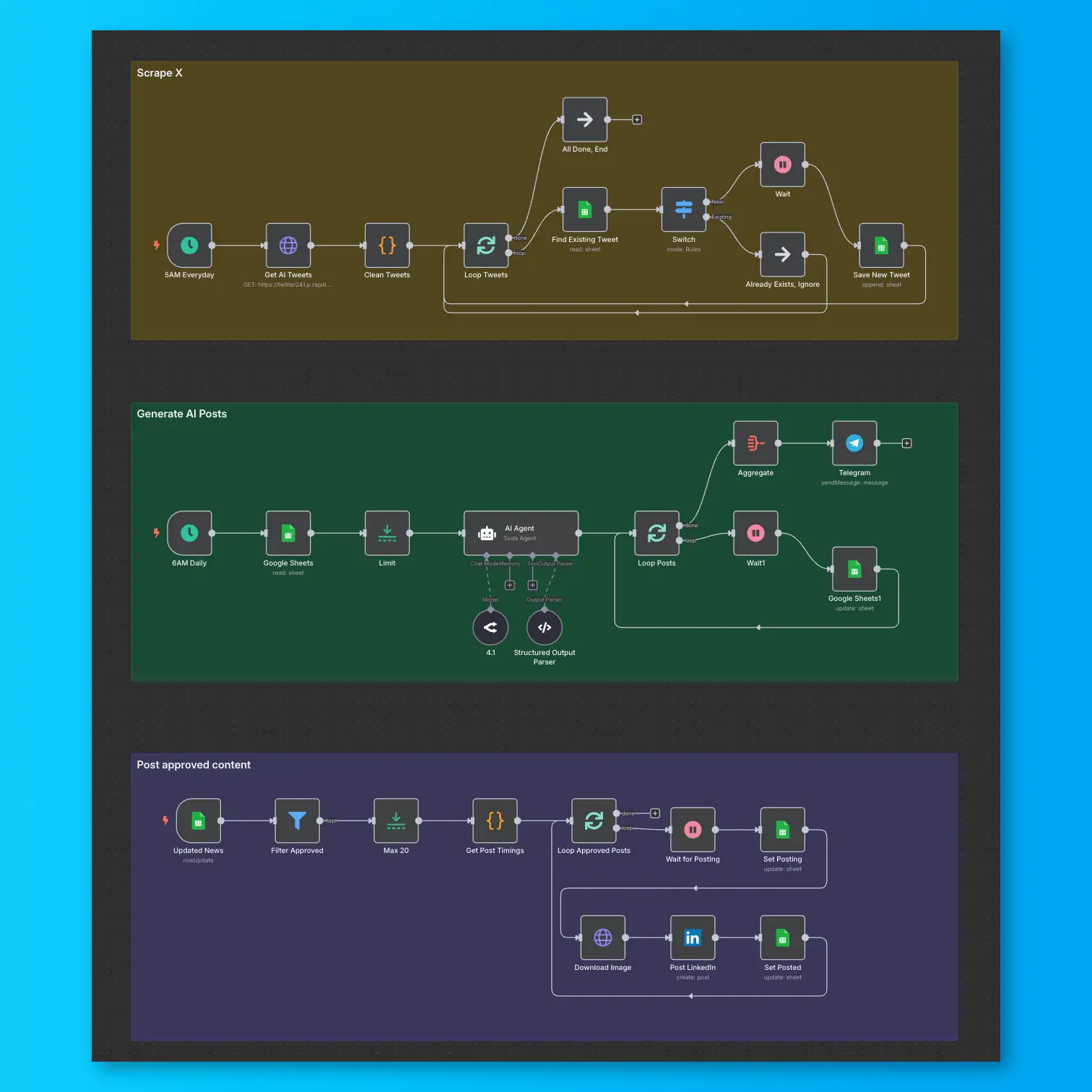
LinkedIn Automation From X Posts
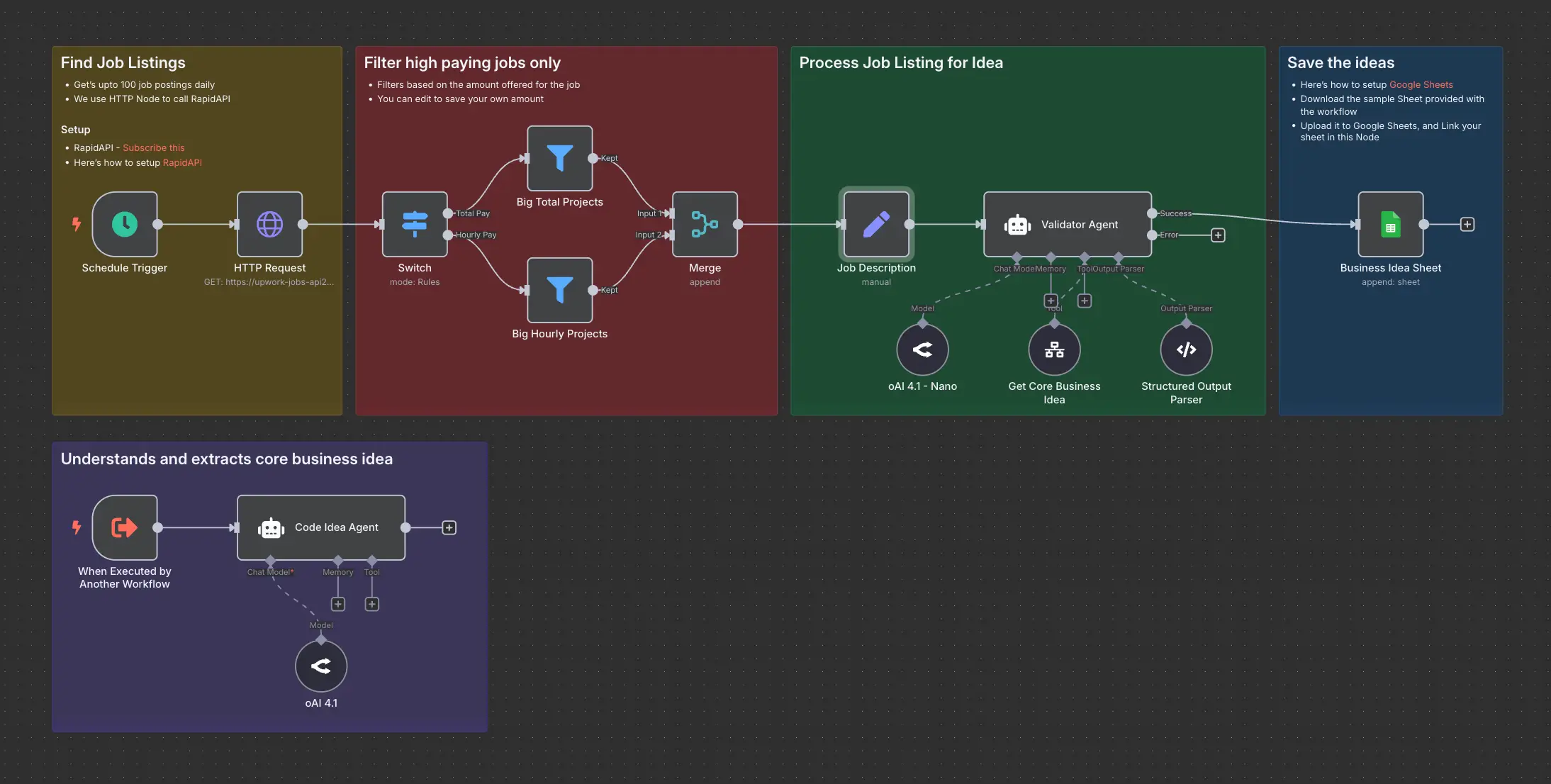
Daily Validated Business Ideas using n8n and Upwork