Claude Routines vs n8n: Where Recurring Ops Run (2026)

Table of Contents
- Introduction
- Why do ops teams still rebuild Monday digests by hand in 2026?
- What are Claude Routines, Managed Agents schedules, Cowork tasks, and n8n?
- What did Anthropic add on June 9, 2026 for Managed Agents scheduling?
- How does n8n Claude integration work for recurring automation in 2026?
- Which three recurring ops jobs are safe to automate first?
- When should Claude Routines own the job vs n8n vs Managed Agents?
- What approval gates should recurring AI workflows use?
- What do Claude Routines vs n8n cost and lock-in look like in practice?
- When should you book a roadmap call instead of picking a tool?
- Frequently Asked Questions (FAQs)
Introduction
Every Monday, someone on your team rebuilds the same briefing. Support themes. Stale leads in the CRM. KPI numbers pulled from three dashboards. Everyone agrees it should run on a schedule. Nobody agrees whether Claude Routines, Managed Agents, Cowork scheduled tasks, or n8n should own it.
The answer is not "pick one and cancel the rest." Claude Routines vs n8n is a boundary question: who owns the cron, credentials, and audit trail, and who owns the thinking. For most small ops teams in 2026, n8n should orchestrate recurring jobs while Claude classifies, summarizes, and drafts. Managed Agents and Cowork fill specific gaps when the work is personal, exploratory, or mostly inside Claude's sandbox.
This guide is for founders and ops leads comparing n8n Claude integration options after Anthropic's June 2026 scheduler updates. You will get three safe starter workflows, a decision matrix, approval gates, and cost caveats. For the broader hybrid stack, see can Claude Code replace n8n? and Claude Skills and n8n orchestration. For Cowork-only digests, see Claude Cowork scheduled tasks vs hiring.
Why do ops teams still rebuild Monday digests by hand in 2026?
Ops teams still rebuild Monday digests by hand because recurring AI automation has four failure modes that no single tool fixes alone: unclear ownership, non-deterministic outputs, opaque AI bills, and zero visibility for people who never open a repo.
The person who understands support themes or lead quality is rarely the person who wants to wire webhooks, rotate API keys, and debug cron failures. So the digest stays manual even when the company already pays for Claude and n8n.
AI outputs also drift. A KPI email that changes tone or ordering week to week makes leadership nervous. Without draft-only phases and logged approvals, "automated" quickly means "we stopped checking."
Cost surprises push teams back to spreadsheets. A long-running Managed Agent session billed per token plus session-hour can dwarf a tight Routine call orchestrated by n8n. Community comparisons routinely show naive agent-for-everything designs costing orders of magnitude more than bounded flows with cheaper models on bulk steps.
Finally, ops needs receipts: what ran, when, with which payload. That is what workflow engines were built for. The fix is not more software. It is a clear split between orchestration and brains, then three low-risk jobs to prove the pattern.
What are Claude Routines, Managed Agents schedules, Cowork tasks, and n8n?
n8n is a workflow engine: cron triggers, SaaS connectors, retries, credential vaults, and execution history your whole team can inspect. It is integration-shaped work.
Claude Code Routines are saved prompts plus repos and connectors that run on a schedule, API trigger, or GitHub event under your claude.ai subscription. They act as you and bill against subscription usage.
Claude Managed Agents scheduled deployments are API-defined agents with cron expressions and timezone. Each run starts a fresh session, uses vault-stored environment variables for CLI auth, and bills per token plus $0.08 per session-hour while the session status is running.
Claude Cowork scheduled tasks are personal standing assignments inside Cowork: /schedule pulls from connected tools and drafts a report you review in chat.
| Layer | Acts as | Best for |
|---|---|---|
| n8n | Production wiring | Schedules, CRM writes, Slack posts, dead-letter queues |
| Routines | You (subscription) | Repeatable logic you prototype in code repos |
| Managed Agents | A service (API) | Multi-step reasoning with tools, hosted cron |
| Cowork tasks | Your assistant | Solo drafts before you promote to team workflows |
The question is never "Claude or n8n." It is which layer owns production behavior for each recurring job.
What did Anthropic add on June 9, 2026 for Managed Agents scheduling?
On June 9, 2026, Anthropic shipped two Managed Agents features in public beta: scheduled deployments (cron without your own scheduler) and vault environment variable credentials (API keys injected at the network boundary so agents never see raw secrets).
Scheduled deployments mean each cron fire starts a new agent session, completes its task, and stops. You can pause, resume, archive, or trigger extra runs from the Claude Platform. Vault credentials register a key with an allowed domain list; CLIs inside the agent sandbox call through a placeholder variable. Rotating a key updates the vault; running sessions pick up the new value on the next call.
That matters for ops because you can now run hosted recurring agent work without maintaining cron on a VPS. It also creates a second scheduler beside Claude Code Routines (subscription-side, acts as you) and beside n8n (your orchestration system of record).
Do not treat Managed Agents cron as a replacement for n8n on day one. Agents excel at internal reasoning loops. n8n still wins when the job is mostly "pull from HubSpot, post to Slack, log failures." The durable pattern is n8n triggers the agent, passes bounded inputs, enforces timeouts, and owns everything customer-facing.
How does n8n Claude integration work for recurring automation in 2026?
n8n Claude integration in 2026 follows a simple loop: schedule or webhook, fetch data, call Claude, parse structured output, write back with human approval.
Store your Anthropic API key in n8n's credential store. Each workflow prepares a prompt and payload (ticket batch, CRM record, KPI JSON), calls Claude via HTTP or AI nodes, parses the response, and continues: Slack draft, CRM update, or dead-letter tab on failure.
Treat Claude n8n skills as reusable nodes once a pattern stabilizes: a "Support Digest" sub-workflow, a "Stale Lead Classifier," a "KPI Narrative" step. Claude owns branching rules and language; n8n owns when it runs and what systems it touches. That is the hybrid stack from can Claude Code replace n8n?, applied to recurring ops instead of one-off builds.
Practical wins: route bulk classification to Haiku-class models and reserve Sonnet for edge cases; swap AI providers at the node level without rewriting connectors; re-run a single failed step from the execution log when a prompt drifts.
Which three recurring ops jobs are safe to automate first?
Start with three jobs that fetch data, summarize or classify, and send a draft for review. They touch revenue indirectly, carry low blast radius if wrong once, and map cleanly to the hybrid pattern.
Score them with what to automate first before you wire anything production-facing.
How do you automate a weekly support themes digest?
Run n8n every Monday morning to pull last week's tickets and tags from your help desk. Group by product area or severity. Call a Claude Routine or Skill to cluster themes, pull two example tickets per theme, and draft a one-pager: top three issues, volume, suggested product actions.
Post the draft to Slack or a shared doc. A human approves before it goes to leadership. After four clean weeks, you can auto-send internal copies while keeping customer-facing text approval-gated.
Cowork scheduled tasks work as a solo prototype for the same digest. Once the format is stable, lift the prompt into a Routine and wrap it in n8n so the whole team shares one workflow, not one person's chat history.
How do you run a stale lead sweep with Claude and n8n?
Nightly or weekly, n8n finds CRM leads untouched for 30+ days, fetches recent emails, calls, and notes. A Claude Routine labels each record: close (low fit), revive (draft follow-up with angle), or review (human).
For revive cases, n8n saves email drafts in your outbound tool. A rep approves in bulk. Nothing sends without a human until error rates stay low. This pairs well with AI lead scoring and routing when you already score inbound; stale sweeps catch what scoring missed.
How do you draft Monday KPI reports without a BI team?
If you still live the pain from still building Monday ops reports by hand, automate the pull first.
n8n runs Monday at 6:30 a.m., fetches revenue, churn, MQLs, trials, and support volume into one JSON snapshot. Claude checks anomalies versus the last four to eight weeks and drafts narrative: what moved, why it might have moved, two follow-up questions.
Post the draft to Slack or email. The ops lead edits and sends. Cowork can deliver this as a personal Monday briefing while n8n remains the data layer.
When should Claude Routines own the job vs n8n vs Managed Agents?
n8n should own any recurring job where connectors, schedules, retries, and team-visible run history matter. That is most production ops work.
Claude Routines should own cognitive, versionable logic called from n8n: classification rules, summarization templates, structured JSON you want in a repo with tests.
Managed Agents with cron fit when the workflow is mostly internal to Claude (long research, multi-tool exploration) and a technical owner accepts metered session-hour cost. For support digests and lead sweeps, embed Agents inside n8n as a power node with timeouts, not as a black box that owns the entire lifecycle.
Cowork scheduled tasks fit when one person prototypes drafts before promoting to team workflows.
| Need | Default owner |
|---|---|
| Pull SaaS data on a schedule | n8n |
| Branchy rules over that data | Claude Routine via n8n |
| Long autonomous tool loops | Managed Agent, supervised by n8n |
| Personal Monday briefing | Cowork, then graduate to n8n |
| Team-visible production job | Hybrid: n8n orchestrates, Claude thinks |
The mistake is treating claude routines vs n8n as a replacement debate. You want one orchestration system of record and one canonical place for business logic, not a new scheduler every quarter.
What approval gates should recurring AI workflows use?
Every recurring AI workflow should start in draft-only mode: automated runs produce output a human must approve before anything customer-facing or CRM-mutating ships.
Add lightweight guardrails in your Routines: never close leads tagged High Fit; never claim KPI growth without stating the comparison window. Failed checks route to human review instead of silent send.
After several clean weeks, grant conditional autonomy: auto-send internal digests; keep approvals on outbound email and financial fields. Log who approved what in Slack reactions, form submissions, or ticket comments.
Assign three names per critical workflow: business owner (what "good" looks like), n8n builder (connectors and schedules), Claude owner (prompts and tests). Without that RACI, incidents become finger-pointing. See who owns n8n workflows for a template.
What do Claude Routines vs n8n cost and lock-in look like in practice?
n8n self-hosted on a small VPS gives negligible marginal cost per execution beyond server spend. n8n Cloud charges per execution but bundles many steps. AI cost is separate: you pay Anthropic per token regardless of where the call originates.
Managed Agents schedules add $0.08 per session-hour on top of tokens. Quick bounded tasks are cheap; exploratory loops add up. Routines under subscription avoid session-hour line items but still consume tokens.
Cost-aware stacks use n8n as the always-on scheduler, Routines for scoped logic, Agents only where autonomy justifies the meter, and cheaper models on bulk steps wired through n8n.
Lock-in appears when recurring jobs live only inside one AI surface with no execution log your ops team can read. n8n as orchestration with Claude as a pluggable node keeps providers swappable and makes the workflow graph the long-lived asset.
When should you book a roadmap call instead of picking a tool?
Book a 45-minute AI roadmap call when you have two or three recurring jobs worth automating but no agreed owner, build order, or split between Routines, Agents, Cowork, and n8n.
That is the common stall: five "AI ideas," tools that do not talk, and Monday digests still manual when volume spikes. On the call we map where work leaks on your customer journey, rank fixes by revenue vs effort, and name which layer owns each recurring job. You leave with a ranked backlog and a hybrid stack sketch, not a retainer pitch.
DIY and tool shopping work for one digest. When support, sales, and finance all want scheduled AI and nobody owns orchestration, prioritization beats another subscription.
Frequently asked questions
Quick answers on the topics covered in this article.
n8n owns schedules, connectors, retries, and execution logs. Claude Routines own the thinking: classification, summarization, and draft text. Production recurring jobs usually need both: n8n orchestrates, Claude processes prepared data.
No for most teams. Routines run under your subscription and act as you; they lack the team-wide audit trail, CRM write patterns, and dead-letter handling n8n provides. Use Routines as logic blocks n8n calls, not as your only scheduler.
API-defined agents that run on cron without you hosting a scheduler. Anthropic added them in public beta on June 9, 2026, with vault credentials for secure CLI auth. They bill per token plus $0.08 per active session-hour.
n8n triggers on cron or webhooks, pulls data from SaaS tools, calls Claude with structured prompts, parses JSON responses, and writes drafts or updates back to CRM and Slack. API keys live in n8n credentials, not in workflow JSON.
Use Cowork when one person prototypes a weekly digest or KPI draft with low setup friction. Graduate to n8n plus Routines when the output must be team-visible, governed, and owned beyond a single chat thread.
Start with a weekly support themes digest, stale lead sweep, or Monday KPI draft. All three fetch data, summarize, and send drafts for approval. They touch revenue indirectly and carry lower risk than customer-facing sends on day one.
Yes. Run draft-only for at least a few weeks. Log approvals, add guardrails in prompts, and only auto-send internal digests after error rates stay low. Keep human review on outbound email and CRM status changes.
n8n self-hosted marginal run cost is near zero beyond hosting. Managed Agents add token charges plus $0.08 per session-hour while running. Bounded Routine calls inside n8n workflows are usually cheaper than long autonomous agent loops.
Encapsulate stable patterns as sub-workflows or documented prompt templates. One n8n owner and one Claude prompt owner per production job prevents duplicate logic in Code nodes and repos.
Book when you have multiple recurring jobs across teams, unpredictable AI spend, or confusion about whether Routines, Agents, Cowork, or n8n should own each job. A session produces a ranked backlog and hybrid stack split you can execute without tool sprawl.
Share this article
Related workflows
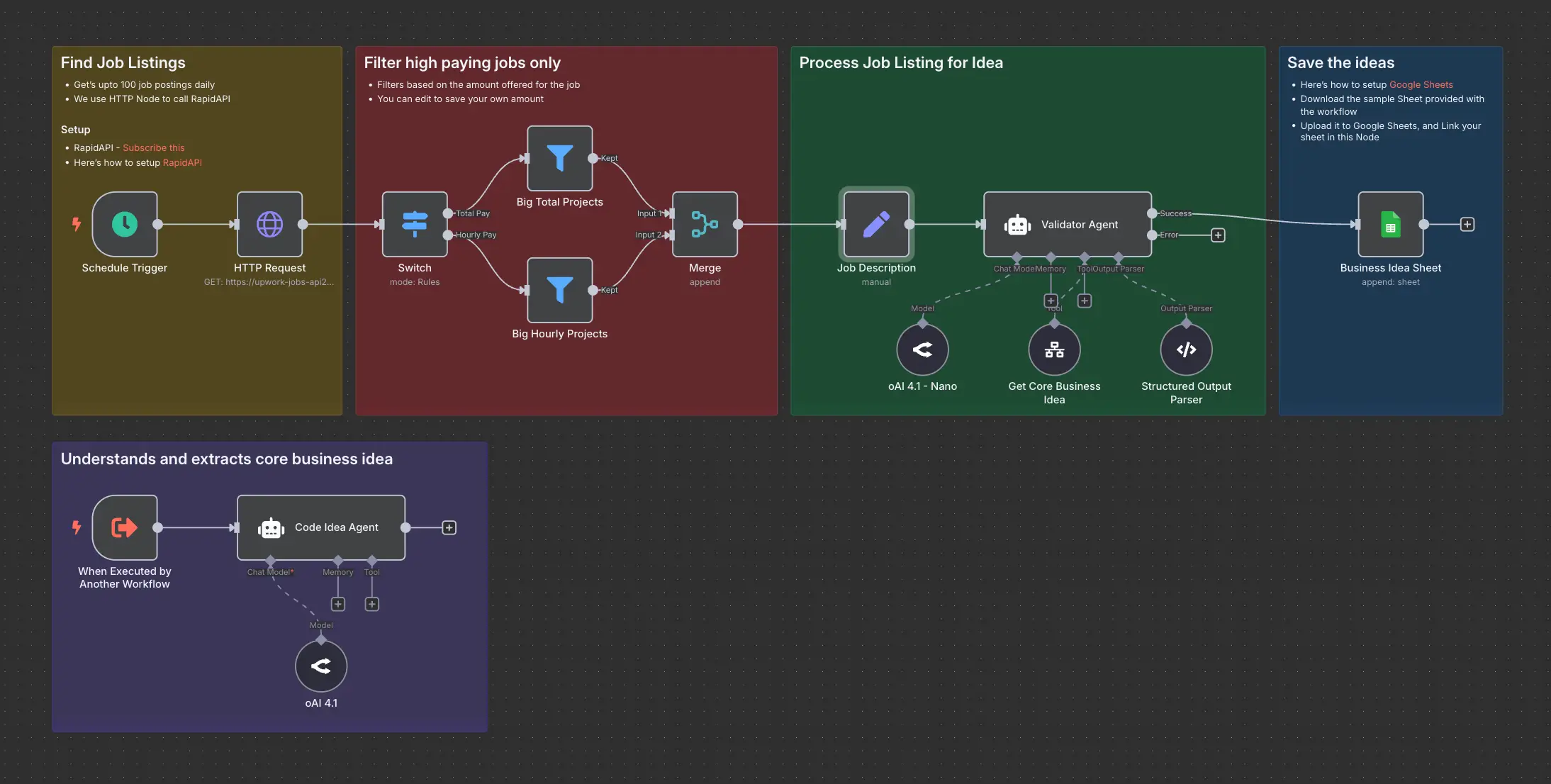
Daily Validated Business Ideas using n8n and Upwork
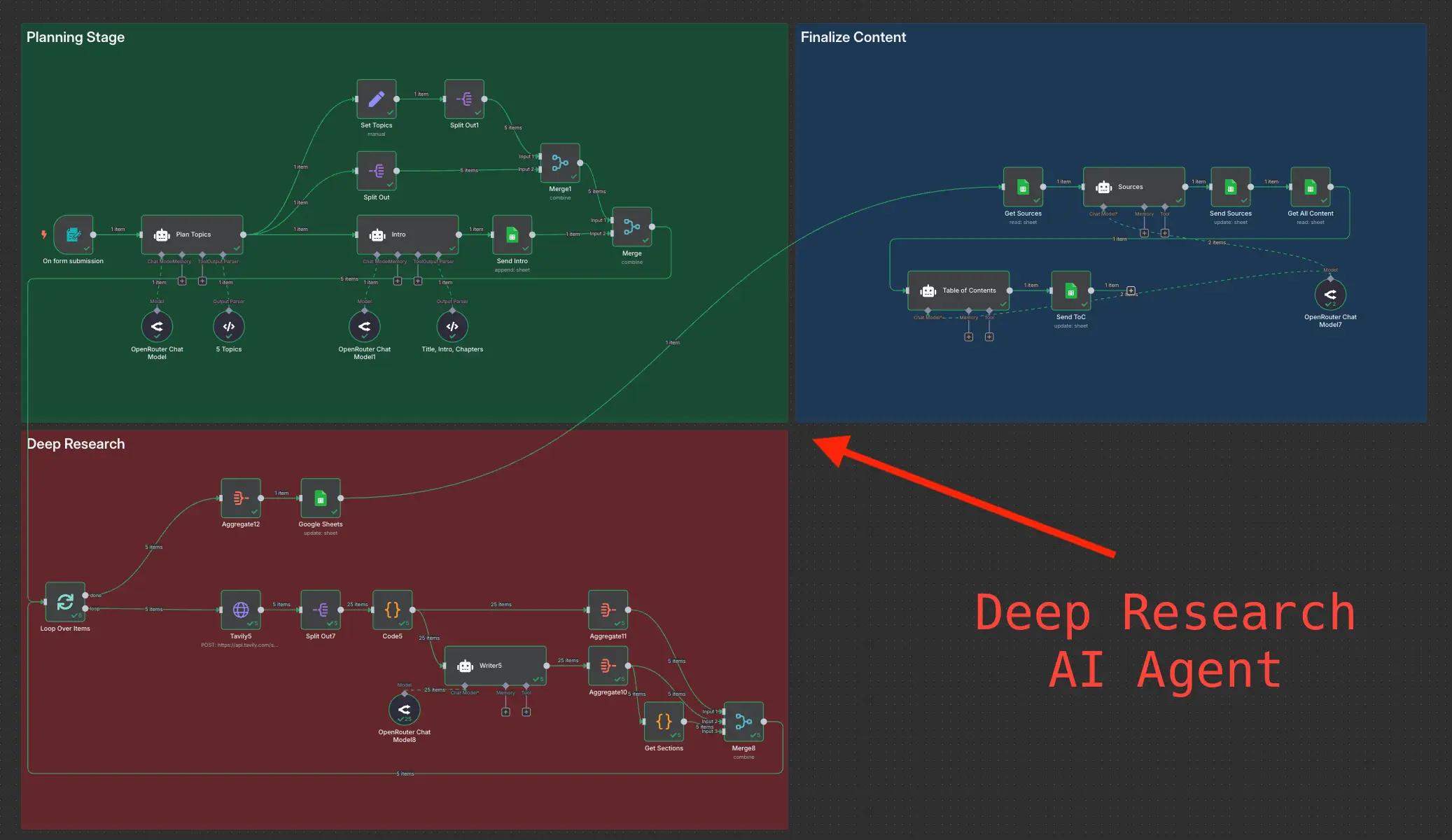
Deep Research using n8n automation to generate report using Tavily