Claude Fable 5 Banned: Keep Ops Automations Running (2026)


Table of Contents
- Introduction
- What happened when Claude Fable 5 was banned globally?
- Why did a foreign-national export order shut down U.S. businesses too?
- How do you triage when Fable 5 API calls fail in production?
- Where is Fable 5 hard-coded in your business automation stack?
- What is the best Claude Fable 5 alternative for live workflows?
- How does a multi-provider AI gateway prevent the next suspension?
- How do you adjust prompts when downgrading from Fable 5?
- What cost and quality tradeoffs come with Fable 5 fallbacks?
- When should you stop waiting for Fable 5 to come back?
- What does a 30-day Fable 5 recovery playbook look like?
- Frequently Asked Questions (FAQs)
Introduction
On Friday your ops dashboard lit up red. Lead intake stopped creating CRM records. Support tickets piled up untriaged. Invoices arrived but never got parsed. Nothing in your stack had changed - until you checked the logs and saw every failing call pointed at claude-fable-5.
If you wired Claude Fable 5 into live business automations during its four-day public window, you were caught in a geopolitical blast radius. This was not a normal outage. On June 12, 2026, the U.S. government issued an export-control directive that forced Anthropic to suspend Fable 5 and Mythos 5 for every customer worldwide. As of June 17, both models remain offline while Anthropic negotiates with Commerce officials.
This post is for founders and ops leads who need a business workflow after the Fable 5 shutdown - not a recap of benchmarks or pricing debates. You need to stop the bleeding, pick a Claude Fable 5 alternative that holds up in production, and rebuild so the next ban does not take revenue with it. If prioritizing which broken workflow to fix first feels overwhelming, there is a link to book a short call at the end.
What happened when Claude Fable 5 was banned globally?
Anthropic released Claude Fable 5 on June 9, 2026 as its new public flagship. Three days later, on the evening of June 12, the company received an emergency export-control directive from the U.S. Department of Commerce citing national security authorities under the Export Administration Regulations.
The order instructed Anthropic to suspend all access to Fable 5 and Mythos 5 by any foreign national - whether inside or outside the United States, including foreign-national Anthropic employees. Anthropic's public statement explains the practical consequence: because the platform cannot verify user nationality on every API request in real time, the only compliant path on short notice was to disable both models for all users globally.
Other Claude models, including Opus 4.8 and Sonnet, stayed online. This is a regulatory suspension of specific frontier models, not a Claude-wide shutdown. Anthropic says it disagrees with the reasoning and is working to restore access, but as of mid-June 2026 there is no public timeline for when Fable 5 returns.
For small businesses, three facts matter immediately. First, this is not a bug you can wait out - access was removed to comply with law. Second, your service agreement does not override a government order. Third, refund options exist for subscribers who paid specifically for Fable access, but refunds do not restart your lead router or invoice parser.
Why did a foreign-national export order shut down U.S. businesses too?
The directive targeted foreign-national access, not U.S. persons in general. Engineering reality turned a nationality-scoped order into a global blackout.
Anthropic serves hundreds of millions of users through API keys, Claude apps, embedded widgets, and partner clouds. Verifying the nationality of every end user on every request - across every customer integration - is not something the platform can do reliably on same-day notice. A wrong guess either violates the order or wrongly blocks a lawful user. So the company chose a blanket shutdown to ensure compliance.
Reporting links the directive to government concern about a claimed jailbreak method that could bypass Fable 5 safety controls. Anthropic's statement says the demonstrated technique affects a narrow set of cases and that similar capabilities exist on other frontier models without a bypass. That dispute is above most ops teams' pay grade. What lands on your P&L is simpler: the model ID in your n8n workflow, Zapier step, or Lambda function now returns errors.
Security analysts frame this as a new category of production risk. The Cloud Security Alliance notes this appears to be the first time the U.S. government directly compelled an AI company to revoke access to specific deployed model versions based on user nationality. Treat frontier model access as a contingent dependency - like a vendor insolvency or a data-center outage - not a permanent utility.
How do you triage when Fable 5 API calls fail in production?
When claude-fable-5 starts returning model-unavailable errors, stabilize before you redesign anything.
Start by containing the blast radius. Search repos, workflow tools, and environment configs for claude-fable-5 and any default-model variables that may still point at Fable. Check server logs and APM dashboards for error spikes beginning June 12 evening. Do not forget no-code glue: Zapier, Make, n8n, Slack bots, and "quick AI helper" widgets someone wired up without a formal rollout. Sort impacts into broken, degraded, and unaffected.
For each broken workflow, ask whether humans can cover it temporarily. Manual lead entry, ticket triage, or invoice parsing is painful, but it buys time to rebuild without rushing dangerous shortcuts into payment flows or customer-facing replies. When money or account access is involved, fail safe and route to a human.
Your fastest AI automation fallback inside Anthropic is usually swapping the model identifier to Opus 4.8, which remained available through the suspension. Change claude-fable-5 to claude-opus-4-8, keep prompts identical for a first pass, and run a sample of real inputs side by side. For many "text in, structured JSON out" automations, Opus is good enough on day one. For complex multi-document synthesis or very tight extraction schemas, expect to tighten prompts - covered in a later section and in more depth in the Fable-to-Opus migration guide.
Do not treat the swap as silent. Track error rates, malformed JSON, tool-call failures, and business KPIs that depend on the workflow - lead-to-opportunity conversion, first-response time, invoice exception rates. Manually review a small daily sample for at least a week so a quiet quality drop does not become a customer-facing surprise.
Where is Fable 5 hard-coded in your business automation stack?
Once the immediate fires are contained, run a proper inventory. The Fable 5 suspension is your signal that "which model are we calling?" belongs in an asset register, not tribal knowledge.
Create a simple spreadsheet or wiki page. For each workflow, record the system name, business owner, model used, provider, and criticality (high, medium, low). Search beyond obvious claude-fable-5 strings: SDK defaults, environment variables, n8n AI Agent nodes, and template fields that say "use Claude Fable 5."
For every Fable touchpoint, document what breaks when the model is unavailable, how severe the revenue or customer impact is, and whether a manual or automated fallback path exists and was ever tested. Many teams discover the fallback branch was scaffolded but never exercised.
Centralize configuration even if you are not ready for a full gateway. Move model IDs into one config file or shared AI client module so the next switch is a single edit, not a repo-wide scavenger hunt. If you want a structured starting point for ranking what to fix first, pair this inventory with an AI automation audit.
What is the best Claude Fable 5 alternative for live workflows?
The right substitute depends on how much change you can absorb in the next thirty days. Most small teams should think in two layers: restore function fast, then add redundancy.
Staying inside Anthropic is the lowest-friction path. Opus 4.8 is the direct substitute for workflows that leaned on Fable's reasoning and long context. Your auth, SDK, and orchestration stay the same; only the model string changes. Sonnet or Haiku may suffice for high-volume, lower-complexity jobs like form normalization, deduplication, or basic routing - and they cost less per token.
The tradeoff is single-vendor and single-jurisdiction risk. Anthropic is a U.S. company subject to U.S. export controls. Opus is less likely to face the same scrutiny as a brand-new frontier release, but the Fable episode proves regulatory action can remove a model overnight.
Adding a second provider is the medium-term fix. You do not need to rip out Claude entirely. Pick one non-Anthropic model, run small experiments on real workloads, and understand how its JSON reliability and refusal behavior compare. For mission-sensitive flows where data locality matters, evaluate a private-cloud open-weight option as a cold standby.
Resist replacing every Fable call with the most expensive available model. Segment workloads into quality-critical and low-volume (contract review, pricing logic), high-volume and low-complexity (CRM normalization, routing), and medium-complexity drafts humans will edit anyway. Match model to task instead of defaulting to flagship everywhere.
How does a multi-provider AI gateway prevent the next suspension?
The cleanest way to survive the next banned or suspended model is a thin gateway between business logic and any single provider.
Instead of every service calling Fable directly, route through your own internal API - something like POST /ai/complete with a task type ("lead-normalization", "invoice-extraction") and payload. The gateway picks the underlying model, retries on failure, and normalizes output schema so downstream code does not care who answered.
You do not need a platform team to start. A single shared AI client module in your codebase can expose functions like extractInvoiceData() and hide provider details. A config file maps each capability to a primary and secondary model. Logging lives in one place: model used, latency, tokens, error codes.
{
  "lead-normalization": {
    "primary": "claude-opus-4-8",
    "fallback": "gpt-4.1"
  },
  "invoice-extraction": {
    "primary": "claude-opus-4-8",
    "fallback": "claude-sonnet-4"
  }
}
The payoff is operational. When Commerce sends another letter, you change routing logic once instead of editing every workflow. n8n, Make, and custom Lambdas all call the same abstraction.
How do you adjust prompts when downgrading from Fable 5?
Fable 5's extra reasoning headroom let many teams run looser prompts. Stepping down to Opus or Sonnet usually requires retuning.
Be more explicit about output shape. Spell out JSON schemas, show correct and incorrect examples, and define missing-data behavior ("output null when a field is absent"). Break multi-step tasks into chained calls instead of one mega-prompt that asked Fable to read three emails, cross-reference a CRM, and rank priorities in a single shot.
Use temperature and max_tokens deliberately. Lower temperature for extraction and deterministic workflows; slightly higher only where humans review creative drafts before send. Add validation outside the model: parse JSON before downstream writes, check that invoice line items sum to the subtotal, and surface anomalies for human review instead of silently accepting them.
Fable also had distinct refusal and automatic Opus fallback behavior for certain high-risk categories. If your workflow touches sensitive domains, read the refusal and fallback risk guide before assuming Opus behaves identically.
What cost and quality tradeoffs come with Fable 5 fallbacks?
Being forced off the top-tier model is a chance to fix a common mistake: using the best model everywhere.
Fable 5 priced at roughly $10 per million input tokens and $50 per million output - about double Opus 4.8. Many teams routed every automation through Fable during the launch window when subscription use was temporarily included. That habit gets expensive fast once you are on metered API billing again.
As you rebuild, reserve premium models for workflows where human time saved clearly exceeds token cost. Push bulk normalization and routing to smaller models. Run a one-week cost comparison on your actual traffic after the swap - you may spend less while gaining resilience.
Quality tradeoffs show up in long-horizon agentic tasks and very large context passes. If a workflow depended on Fable's 1M-token window or multi-hour reasoning chains, Opus may need narrower scope or a split architecture. Measure on your data; do not assume parity from benchmarks alone.
When should you stop waiting for Fable 5 to come back?
Treat Fable 5 as indefinitely suspended for planning purposes.
Anthropic is negotiating with the U.S. government and has not published conditions or a restoration date. External analysis as of June 17 still shows no confirmed timeline. Refunds and subscription adjustments help cash flow but do not restart production pipelines.
You should not leave revenue workflows broken or fully manual for weeks hoping for a regulatory resolution. Do not design new systems around Fable on the assumption it returns "any day now." Do not promise customers a quick fix that depends on government action outside your control.
If Fable returns, reintroduce it as an optional accelerator behind your gateway - not the backbone. The teams that recover fastest are the ones that moved on June 13, not the ones refreshing status pages on June 17.
What does a 30-day Fable 5 recovery playbook look like?
Days 0-3: stabilize. Prioritize cash-flow and customer-facing flows - invoicing, lead response, support triage. Assign temporary human owners where needed. Swap Opus 4.8 into low-risk automations and test on sample data. Tell the team what is broken, what is manual, and where to be careful.
Days 3-10: audit and strengthen. Complete the AI inventory. Refine Opus substitutions with tighter prompts and validation. Pick one secondary provider and run small real-data experiments. Centralize model IDs and API keys behind a shared client.
Days 10-20: gateway. Wrap model access behind one internal API or module. Define primary and fallback per capability. Normalize response schemas. Log model, latency, tokens, and errors on every call.
Days 20-30: optimize and harden. Use logs and KPIs to right-size model tiers. Write a one-page AI dependency policy: every critical workflow needs a tested fallback, model IDs live in central config, and regulatory suspension triggers the same incident response as an outage. Back up prompts, schemas, and configs locally so you can move providers under pressure.
At day thirty you should be in a position where Fable 5 was one model behind an interface - not the interface itself. If the rebuild order still feels unclear, use the what to automate first framework to rank fixes by revenue impact.
The Fable 5 shutdown is a preview, not an anomaly. Export controls and national-security scrutiny are now part of the operating environment for frontier AI. You cannot control that, but you can decide how fragile your business is when the headline model disappears.
If you want help mapping Fable dependencies, picking high-ROI substitutions for the next two weeks, and sketching a lightweight multi-provider gateway that fits your stack, book a 45-minute AI roadmap call. We will rank what to fix first so you are not rebuilding everything at once.
Frequently asked questions
Quick answers on the topics covered in this article.
The U.S. export-control directive ordered Anthropic to block foreign-national access to Fable 5 and Mythos 5. Because Anthropic cannot verify each user's nationality on every API request in real time, the company disabled both models globally to ensure compliance. U.S. customers were caught in the same shutdown.
As of June 17, 2026, Fable 5 and Mythos 5 remain offline worldwide. Anthropic says it is working with the U.S. government to restore access but has not announced a timeline. Plan production workflows as if the suspension is indefinite.
Opus 4.8, Sonnet, Haiku, and other non-Fable Claude models stayed available through the suspension. Anthropic's statement and third-party analyses confirm the export order targeted Fable 5 and Mythos 5 specifically, not the entire Claude API.
Swapping claude-fable-5 to claude-opus-4-8 in your API calls is usually the fastest fix because auth, SDKs, and orchestration stay the same. Test on real inputs, monitor KPIs for a week, and tighten prompts if output quality or JSON shape drifts.
Search code, env configs, and no-code tools for claude-fable-5, default model variables, and AI Agent nodes. Check logs for error spikes starting June 12, 2026. Build an inventory listing each workflow, owner, criticality, and whether a fallback was ever tested.
No. Do not leave revenue or customer workflows broken while waiting on regulatory negotiations. Rebuild on Opus or another model now, and treat any future Fable access as optional behind a gateway - not your sole dependency.
A thin internal layer - often a shared client module or /ai/complete API - that routes requests by task type to a primary model and automatically retries on a secondary model if the first is unavailable. Downstream code sees one schema regardless of provider.
Make output format explicit with schemas and examples, split complex tasks into smaller chained calls, lower temperature for extraction workflows, and validate JSON plus business rules (totals, required fields) before writing to CRM or ERP systems.
Yes for sessions defaulting to Fable 5. Active Fable sessions ended with errors after the shutdown. Switch defaults to Opus 4.8 or another available model in Claude Code (/model) or Cursor model settings until Fable returns.
Book a roadmap call when multiple revenue workflows are down, you cannot tell which automations hard-coded Fable, or you need a ranked 30-day plan for fallbacks and multi-provider routing without rebuilding everything blindly.
Share this article
Related workflows
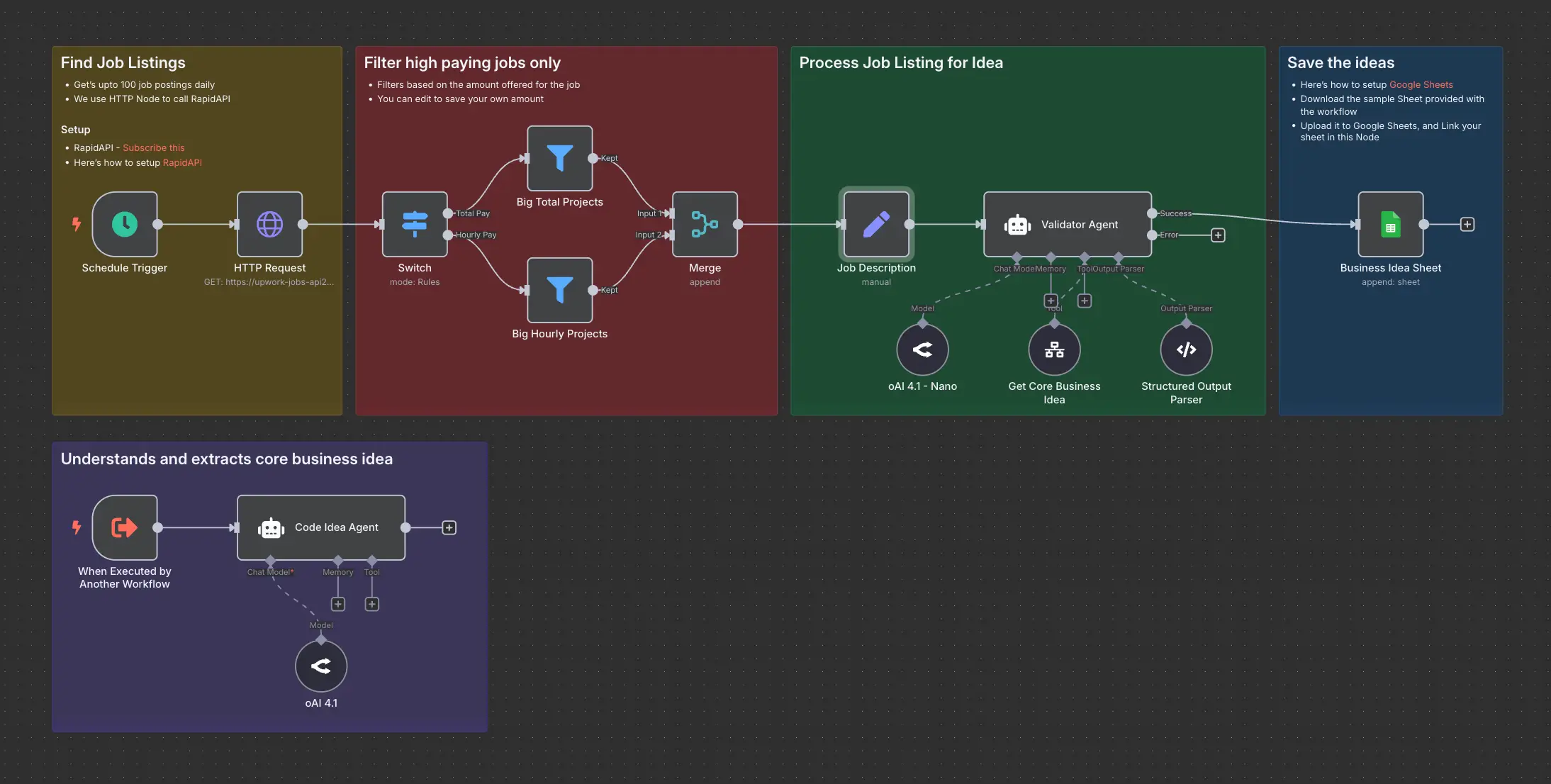
Daily Validated Business Ideas using n8n and Upwork