AI Consultant vs Agency vs Freelancer: Who Should You Hire?
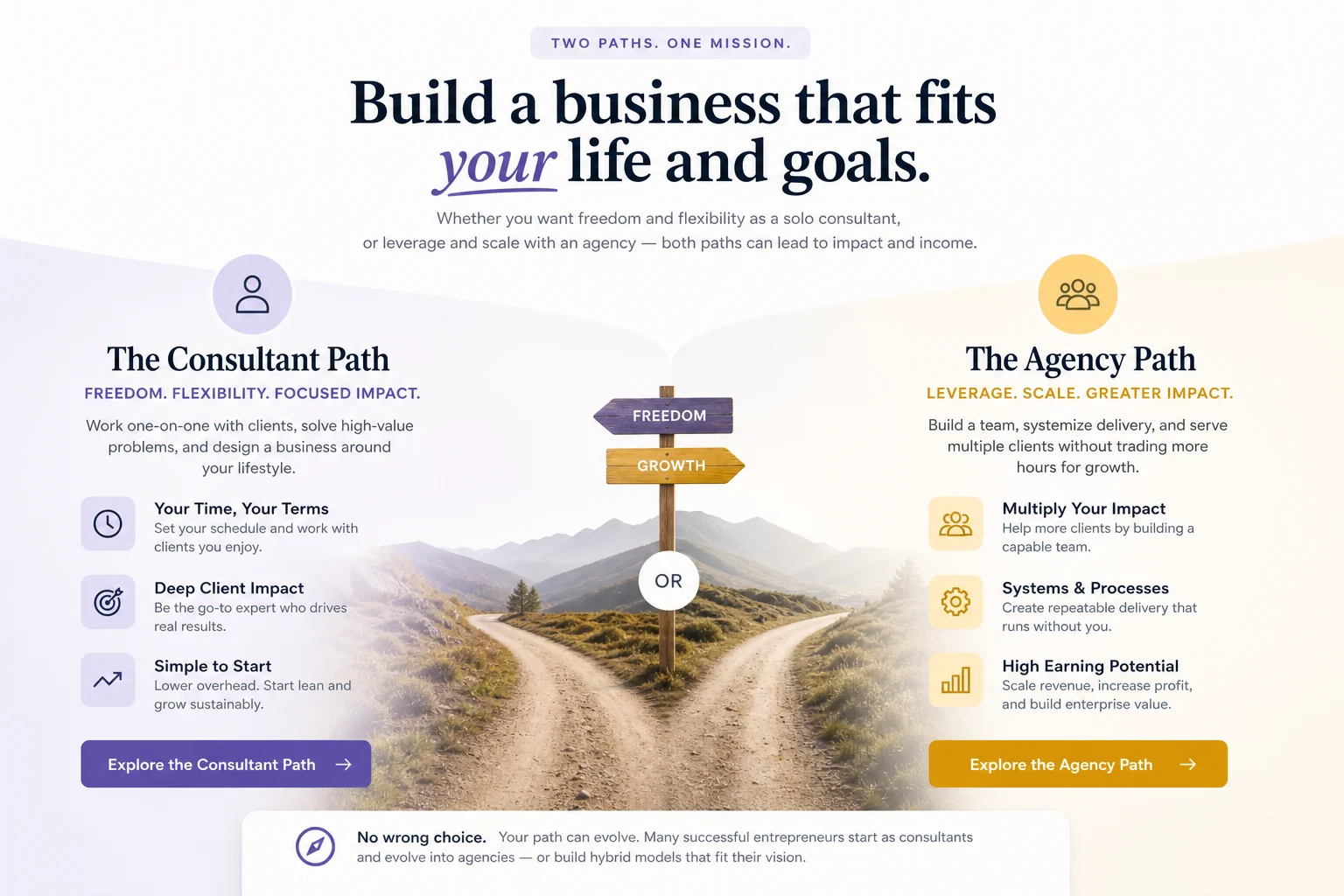

Table of Contents
- Introduction
- What does AI automation mean when you hire an AI automation consultant?
- How does an independent AI consultant differ from an AI automation agency?
- When should you hire a freelance AI implementer instead of a consultant or agency?
- What are typical cost ranges for AI consulting agency vs freelancer engagements?
- Which engagement models fit small business AI automation projects?
- What red flags should you watch for when you hire AI automation help?
- Why is a paid 45-minute roadmap call smart before $10k+ agency work?
- How do you choose consultant, agency, or freelancer for your situation?
- Frequently Asked Questions (FAQs)
Introduction
Small businesses are under pressure to "add AI," but the moment you decide to hire AI automation consultant help, you hit a wall of labels: independent consultants, full-service agencies, and freelancers on marketplaces. They all promise more leads, less manual work, and happier customers-with very different price tags and levels of support.
Choosing the wrong model often means an expensive prototype nobody uses, or an overbuilt system that does not match how your team actually works. This guide compares AI consulting agency vs freelancer paths (plus the consultant in the middle) with current mid-2020s pricing patterns, engagement models, and red flags. It also explains why a focused, paid 45-minute roadmap session is often the lowest-risk first step before you sign a five-figure agency retainer.
What does AI automation mean when you hire an AI automation consultant?
Before you compare providers, be concrete about the job. For most small businesses, "AI automation" is not training a custom model from scratch. It is using AI-powered tools and integrations to streamline workflows you already run:
- Capturing and qualifying leads from forms or chat, then pushing them into your CRM with the right fields.
- Automating follow-ups by email, SMS, or voice based on pipeline stage or behavior.
- Handling common support questions with AI chat or voice before a human takes over.
- Routing, tagging, and summarizing inbound email or tickets so your team replies faster.
- Moving data between systems (form to spreadsheet to invoice) without copy-paste.
- Giving staff lightweight assistants that pull from the tools you already pay for.
Most builds combine off-the-shelf pieces: large language models, automation platforms (Zapier, Make, n8n, and similar), CRMs, and help desks. Whoever you hire AI automation consultant talent through should be strong at four things: understanding your processes, picking tools, implementing reliably, and measuring impact. Consultants, agencies, and freelancers weight those four differently.
How does an independent AI consultant differ from an AI automation agency?
Independent AI automation consultant
Usually a senior individual with strategy and hands-on implementation. They audit workflows and your stack, help you prioritize, sketch architecture, often build the first workflows themselves (sometimes with subcontractors), and stay involved as an advisor. Best when you need tailored automation without hiring a whole external department.
AI automation agency
A team: consultants, engineers, sometimes designers and data specialists. More formal discovery, wider service range (custom apps, voice agents, multi-department automation), project management, and QA. Enterprise shops run six-figure programs; boutique agencies increasingly serve small and mid-market with reachable minimums.
Freelance AI implementer
Ranges from strong engineers to generalists on gig platforms. They execute defined tasks: a chatbot, a Zap, an n8n workflow between two tools. You usually act as product manager unless they explicitly sell strategy.
Side-by-side comparison
| Aspect | Independent consultant | Agency | Freelancer |
|---|---|---|---|
| Typical provider size | Solo or very small team | Often 5-50+ people | Individual |
| Primary focus | Diagnose, prioritize, design, implement key flows | Larger multi-workflow or multi-team programs | Build a defined feature or integration |
| Best for | SMBs needing tailored automation, founder-level attention | Bigger scope, compliance, parallel workstreams | Narrow experiments, tight budgets |
| Typical SMB project | Roughly $5k-$25k build; $500-$3k/mo support | Roughly $10k-$50k+ build; $1k-$5k+/mo retainers | $50-$200/hr or fixed micro-projects |
| Strengths | Business context, flexibility, fast iteration | Capacity, breadth, resilience if someone leaves | Low cost for small, clear tasks |
| Risks | Limited bandwidth | Overhead, higher minimums, generic playbooks | Weak strategy, QA, and maintenance |
All three can be right. Scope, budget, internal skills, and risk tolerance matter more than the label on the website.
When should you hire a freelance AI implementer instead of a consultant or agency?
Freelancers shine when you already know what to build and can write a tight spec. Examples: wire Meta lead ads into HubSpot, add a website chatbot with three intents, or connect Typeform to Slack with a summarization step.
They struggle when you need discovery, cross-system architecture, or ongoing optimization. If nobody on your side can own priorities, metrics, and acceptance tests, a freelancer alone often produces something that works in a demo and frays in production.
Use a freelancer when:
- Budget is roughly $500-$2,000 for a single workflow.
- You have validated the use case (even informally).
- You own accounts, credentials, and documentation requirements.
Use a consultant or agency when:
- You are not sure which workflows matter first.
- Data quality, compliance, or CRM limitations might block the obvious idea.
- You need three or more integrated workflows with shared monitoring.
What are typical cost ranges for AI consulting agency vs freelancer engagements?
Market data for small and mid-size businesses (mid-2020s) clusters around these patterns. Individual providers vary; scope drives cost more than the word "agency" on the invoice.
| Tier | What you get | Typical one-time build | Typical ongoing |
|---|---|---|---|
| Strategy audit only | Workflow map, opportunity scoring, architecture sketch | $1,500-$2,500 | N/A (implementation separate) |
| Starter (1-3 workflows) | Lead capture, CRM sync, basic follow-up | $5,000-$8,000 | $500-$800/mo |
| Growth (4-8 workflows) | Multi-system integrations, richer AI logic, training | $8,000-$15,000 | $800-$1,500/mo |
| Full operations (8+ workflows) | Cross-department automation, monitoring | $15,000-$30,000 | $2,000-$5,000/mo |
Freelancer economics: often $50-$200 per hour in developed markets, or fixed fees from a few hundred to a few thousand dollars for a single deliverable. Cheaper on paper, but hidden cost is your time managing scope and fixing drift when tools change.
Agency economics: higher floors because account management, QA, and bench depth are built in. Worth it when parallel workstreams or formal documentation matter.
Consultant economics: often overlap agency ranges on build size, but you usually get more direct access to the person designing the system. Many serious consultants use project-based pricing for builds (milestones: deposit, mid-project, go-live) rather than open-ended hourly billing.
Experienced practitioners in developed markets commonly bill $150-$350 per hour when hourly is used; audits and small tweaks fit hourly, multi-workflow builds should be scoped fixed-fee.
Which engagement models fit small business AI automation projects?
Project-based builds
Best practice for most SMB automation: fixed fee for defined scope ("these five workflows, these integrations, staff training, 30 days hyper-care"). Aligns incentives: the provider is rewarded for shipping, you get cost certainty.
Retainers after launch
Automation needs monitoring, prompt tweaks, and occasional re-architecture when your process or stack changes.
- Light maintenance ($500-$1,000/mo): monitoring, small fixes, monthly check-in.
- Active optimization ($1,000-$2,500/mo): experiments, new branches, reporting.
- Embedded partner ($2,500+/mo): continuous backlog, closer to fractional ops.
Hourly and discovery-only
Hourly works for short audits or repairs. Be cautious on open-ended hourly builds without caps; scope creep is common when AI steps multiply inside a workflow graph.
What red flags should you watch for when you hire AI automation help?
Whether you are evaluating an AI consulting agency vs freelancer quote or a solo consultant, walk away when you see:
- Tool-first pitching. They lead with "we use ChatGPT and n8n" before asking about lead volume, close rates, or where hours disappear.
- No structured discovery. Pricing appears without discussion of workflows, data, or success metrics.
- Guaranteed revenue multiples. "3x revenue in 30 days" ignores your offer, traffic, and sales motion.
- Launch-only mindset. No plan for monitoring, failure handling, or iteration when models drift.
- Vague ownership. Unclear who owns prompts, workflows, and credentials; no plain-language data handling story.
- Open-ended hourly for large builds. Refusal to scope fixed phases often signals weak estimation or comfort with your budget bleeding.
- Jargon without translation. If they cannot explain trade-offs using your business examples, alignment will hurt later.
Positive signals: they recommend a phased plan, push back on weak ideas, tie automation to measurable ops or revenue metrics, and describe how handoffs work between AI and humans.
Why is a paid 45-minute roadmap call smart before $10k+ agency work?
Many owners want to skip straight to a $15,000 agency SOW. That is often premature. A paid, focused roadmap session (about 45 minutes, sometimes plus a short written summary) is one of the highest-ROI steps before a large commitment.
1. It changes the incentive. Free "strategy calls" are sales calls. A paid session compensates the provider for thinking about your business, not just qualifying you for a pipeline stage. You show up with numbers; they show up having reviewed your stack.
2. You get a shared map. A good session produces tangible outputs even if brief: core workflows sketched (lead capture to follow-up to close), automation opportunities ranked by effort vs value, a rough architecture (where AI belongs vs simple rules), and order-of-magnitude cost and timeline for phases. That baseline lets you compare AI consulting agency vs freelancer proposals apples to apples-or take the map to a second opinion.
3. It reduces mis-scoping risk. Most failures are wrong priorities, not bad code. Early sessions surface constraints ("your CRM cannot do that integration yet," "data is too messy to automate this step"). You define success in numbers (response time, ticket deflection, hours saved) and can fund phase one instead of an all-in blind build.
4. It is a low-cost provider test. You see how they ask questions, connect automation to your model, and handle uncertainty. A shallow session costs hundreds, not five figures.
5. It aligns process expectations. You learn communication rhythm, what they need from your team, and how they report results-before anyone writes a large statement of work.
Fair pricing for a senior-led SMB roadmap (mid-2020s): roughly $200-$750 for 45-90 minutes with a concise follow-up; deeper strategy audits with documentation often run $1,500-$2,500. Some providers credit part of the fee toward a later build if you proceed together.
That is exactly what I run on the 45-minute roadmap call page: a working session, not a generic AI pitch. You leave with ranked priorities, named tools, and clarity on DIY vs hiring a build.
How do you choose consultant, agency, or freelancer for your situation?
Scenario A: Local service business (roughly 5-15 people). Leads slip, staff drowns in follow-ups, stack is website forms plus a basic CRM.
Scenario A: Local service business (roughly 5-15 people). Leads slip, staff drowns in follow-ups, stack is website forms plus a basic CRM. Budget $5k-$15k over a few months plus $500-$1,500/mo after.
- Start with a paid roadmap session with an independent consultant or small boutique agency.
- Phase one: lead intake, qualification, and follow-up automation.
- Hire the consultant for a starter or growth build; skip the large agency until complexity grows.
Scenario B: Growing online business (30-200 people). Sales, marketing, support, and ops each have different tools; you want AI-assisted support and internal assistants.
- Budget $20k-$50k+ year one.
- Deeper roadmap (maybe more than 45 minutes) with an agency or senior consultant who knows your vertical.
- Choose an agency if you want them to own PM across teams; choose a consultant if you want a strategic lead orchestrating internal devs.
- Use freelancers for narrow implementation under that lead.
Scenario C: Solo or micro business. You want one experiment (chatbot or email triage) on $500-$2,000.
- Short paid consult to avoid obvious mistakes, then a freelancer with clear specs.
- Own all accounts; demand documentation.
- Revisit consultant or agency when revenue and workflow count justify it.
The through-line: match provider type to scope, buy clarity before scale, and measure automation against workflows and numbers-not buzzwords.
If you are deciding who to hire and do not want to commit to a five-figure build blind, book a 45-minute roadmap call. It is a paid working session: we map where work leaks, rank fixes by revenue impact, name tools you already pay for, and outline DIY vs build-so your next step is informed, not another generic AI pitch.
Frequently asked questions
Quick answers on the topics covered in this article.
Start with clarity, not size. If you have one to three high-impact workflows and want founder-level attention, an independent consultant or small boutique agency is usually enough. If you need parallel work across departments, formal QA, and heavier documentation, an agency fits better. A paid roadmap session before either helps you choose with a shared scope baseline.
Agencies and consultants typically own discovery, architecture, and multi-step builds; freelancers execute defined tasks cheaply when you already have specs. Agencies add team capacity and process overhead; freelancers add flexibility and lower hourly cost but shift strategy and project management to you.
For most small businesses, a one-time build runs roughly $5,000-$25,000 depending on workflow count and integrations. Ongoing management often falls in $500-$4,000 per month. Hourly rates for experienced practitioners commonly land in $150-$350 per hour when billed that way. Strategy-only audits are often $1,500-$2,500.
When budget is limited, the use case is narrow, and someone internal can write acceptance criteria and own accounts. Examples: single chatbot, one CRM integration, or a pilot between two tools. Not ideal when priorities are unclear or data and compliance need upfront design.
A workflow sketch of how leads or work move today, ranked automation opportunities, rough architecture (which tools, where AI vs rules), ballpark cost and timeline for phases, and clarity on DIY vs external build. It should feel like working session output, not a slide deck sales pitch.
Free calls optimize for selling the next package. Paid sessions compensate focused analysis on your numbers and stack, which improves preparation on both sides and reduces the chance you fund the wrong $10k+ project.
Guaranteed revenue claims, no discovery, tool-first demos, no monitoring plan, vague data ownership, and refusal to scope fixed phases for larger builds. Also beware providers who cannot explain trade-offs in plain language tied to your business.
Not necessarily. Tools do not replace process design. If your graphs are simple and owned internally, a freelancer or short consult may suffice. If workflows cross teams, need governance, or keep breaking at volume, a consultant or agency helps you redesign with metrics and maintenance in mind.
Yes. A good roadmap is provider-agnostic: priorities, metrics, and architecture sketches. You can take it to multiple bidders or your internal team. Ethical providers expect you to compare; the session is buying clarity, not lock-in.
You are ready when you have a ranked backlog from discovery, defined success metrics, realistic data and CRM constraints documented, budget for build plus three to six months of iteration, and an internal owner who can test and give feedback. If those are missing, pay for roadmap work first instead of accelerating a large SOW.
Share this article
Related workflows
LinkedIn Automation From X Posts
Daily Validated Business Ideas using n8n and Upwork